|
This section introduces the idea of equivalent fractions.
These are fractions which appear differently but have the same value
Look at this diagram.
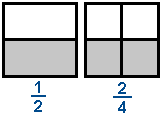
We can see that the fraction shaded in the left-hand shape is  ,
and the fraction shaded in the right-hand shape is ,
and the fraction shaded in the right-hand shape is  . .
The same proportion of the shape is shaded in total, so these two fractions must be the same:
| 1 |
= | 2 | |
|  |
| |
| 2 |
4 | |
Now look at this diagram.
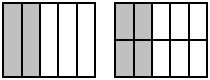
Again, the same fraction of each shape is shaded in total, so the two fractions must be equal:
| 2 |
= | 4 | |
| |
| |
| 5 |
10 | |
We say that these fractions are equivalent, because they have the same value.
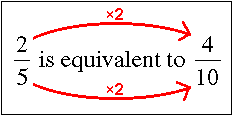 |
You might have noticed something else about the equivalent fractions. Look at the diagram on the left.
Both the numerator (the top number) and the denominator (the bottom number) have been multiplied by the same value.
|
If we multiply or divide the top and bottom numbers in a fraction by the same value,
we will get an equivalent fraction.
|
Example Questions
Work out the answer to each of these questions then click on the button marked
 to see whether you are correct.
(a) Are these two fractions equivalent?
| 3 |
and | 9 | |
| |
| |
| 4 |
12 | |

(b) What number should go in place of the question mark?
| 1 |
= | ? | |
| |
| |
| 3 |
12 | |
Exercises
Work out the answers to the questions below and fill in the boxes. Click on the
 button to find out whether you have answered correctly. If you are right
then
button to find out whether you have answered correctly. If you are right
then  will appear and you should move on to the next
question. If will appear and you should move on to the next
question. If  appears then your answer is wrong. Click
on to clear your original answer and have another go.
If you can't work out the right answer then click on appears then your answer is wrong. Click
on to clear your original answer and have another go.
If you can't work out the right answer then click on
 to see
the answer. to see
the answer.
Question 1
The three diagrams below represent the same fraction; they are equivalent fractions.
Write down the three different (but equivalent) fractions represented by the diagrams below.
Question 2
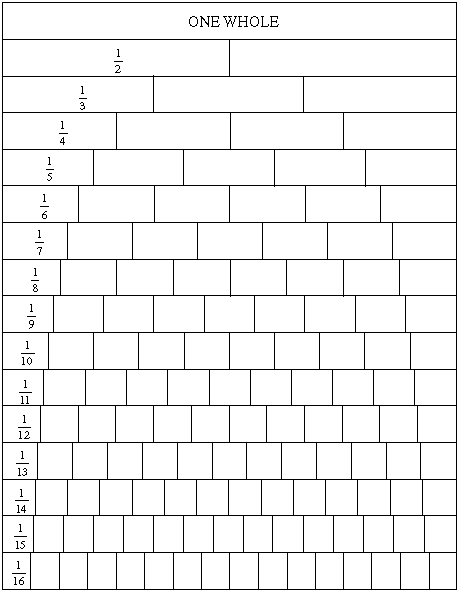
Work out the missing number on each of these questions. You may find the diagram on the right useful.
Question 3
Work out the missing number on each of these questions. You can use the diagram on the right to help you, but try
using the method of multiplying the numerator (top) and denominator (bottom) by the same value.
For example, in part (a) both parts of the fraction need to be multiplied by 4.
Question 4
In this question you have to divide both parts of the fraction by the same number to get the equivalent fraction.
For example, in part (a) both parts of the fraction need to be divided by 5.
If we keep dividing both parts of the fraction by the same number until there are no more
numbers which we can divide by, the number is said to be in its simplest form.

Question 5
Write each of the fractions below in its simplest form.
Question 6
By thinking about equivalent fractions, indicate whether each of the statements below is true of false.
Produced by Al Reynolds for CIMT
|