|
In this section we look at how to write fractions as decimals.
Method 1
If the fraction has 10, 100 or 1000 as the denominator, we can reverse
the process we used to convert decimals to fractions.
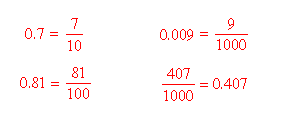
You should already know that:
To convert  to a decimal,
we need to write 37 so that the last digit appears in the hundredths column, i.e. 0.37. to a decimal,
we need to write 37 so that the last digit appears in the hundredths column, i.e. 0.37.
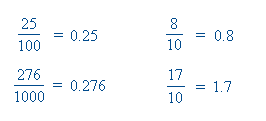
From this we can see that:
Method 2
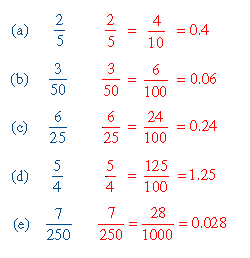
If the fraction isn't like the one above, we may be able to change it to an equivalent fraction
which does
have 10, 100 or 1000 as the denominator. The fractions can then be converted in the same way as before.
Look at the examples below:
Method 3
Sometimes we are not able to find an equivalent fraction which has 10, 100 or 1000 as the denominator.
In these cases, we need to divide the numerator by the denominator.
For example, we saw before that  converts to 0.37 converts to 0.37
If we calculate 37 ÷ 100, we also get the answer 0.37 |
So, to write  as a decimal, we need to calculate 5 ÷ 8: as a decimal, we need to calculate 5 ÷ 8:
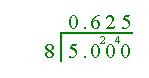
So  = 0.625 as a decimal. = 0.625 as a decimal.
Practice Questions
Convert each of these fractions into decimals, then click
 to see whether you are correct.
Exercises
Work out the answers to the questions below and fill in the boxes. Click on the
 button to find out whether you have answered correctly. If you are right
then
button to find out whether you have answered correctly. If you are right
then  will appear and you should move on to the next
question. If will appear and you should move on to the next
question. If  appears then your answer is wrong. Click
on to clear your original answer and have another go.
If you can't work out the right answer then click on appears then your answer is wrong. Click
on to clear your original answer and have another go.
If you can't work out the right answer then click on
 to see
the answer. to see
the answer.
NOTE: Do not use a calculator in any of these questions.
Produced by Al Reynolds for CIMT
|