Fractions 2
Equivalent Fractions

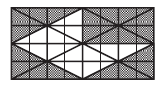
It is easy to see from the diagram opposite that

and

are equivalent fractions, i.e. they both have the same value.

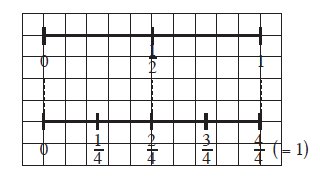
Another way of looking at this is to note that the fractions are at the same place on a number line.
Worked Examples

1

Use the diagram below to shade of the rectangle in different ways.
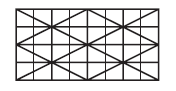
Show me
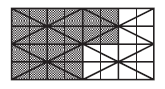
Here are two possible answers.

In fact, shading any 20 of the small triangles (out of 32) gives the fraction (which is equivalent to or , etc.).

Exercises

The diagrams show that is equivalent to .

Colour the diagrams below to show that is also equivalent to .

Use the diagrams below to show that = = .

Write down the equivalent fractions shown by these diagrams.

Use the following diagram to fill in the missing numbers.

(a)
= = = = = = =
(b)
= = = =
(c)
= = =
(d)
= =
(e)
=
(f)
=
(g)
=

Write down the missing numbers.

(a)
=
(b)
=
(c)
=
(d)
=
(e)
=
(f)
=
(g)
=
(h)
=
(i)
=
(j)
=
(k)
=
(l)
=

Write out each of these pairs of fractions, inserting either a < or a > into each one to make it correct.

(a)
(b)
(c)
(d)
(e)
(f)
(g)
(h)
(i)
(j)
(k)
(l)

Write down the missing numbers.

(a)
=
(b)
=
(c)
=
(d)
=
(e)
=
(f)
=
(g)
=
(h)
=
(i)
=
(j)
=
(k)
=
(l)
=

Write each set of fractions in increasing order.

(a)

, , , ,

< < < <

(b)

, , ,

< < <

(c)

, , ,

< < <

(d)

, , , ,

< < < <

(e)

, , , ,

< < < <

Write each fraction in its simplest form.

(a)
(b)
(c)
(d)
(e)
(f)
(g)
(h)
(i)

State whether each of the following is true or false.

(a)
>
(b)
=
(c)
=
(d)
>
(e)
>
(f)
<
(g)
>
(h)
<
(i)
=