
By using the bracket and memory keys on a calculator it is possible to carry out tasks fairly quickly and easily.
Some of the standard memory keys which are found on a calculator are:
or Places the current number into the memory, replacing any previous number.
Clears the memory.
Adds the number displayed to the memory.
Recalls the number that is currently in the memory.
Brackets can be used to tell the calculator the order in which to do calculations.
For example, to find:
use
Worked Examples
Find:
Use the brackets as shown below
to obtain 0.6.
Use brackets to enclose the top part of the fraction ,as shown below,
to obtain 0.5835 correct to 4 decimal places.

Follow the instructions given in the flow chart for a student who chooses the number 20 as a starting point.
Starting with 20 leads to the calculation
= 1.1
To perform the remaining calculations, follow the steps below.
1. Press to place the value displayed in the memory.
2. Press which adds 2 to the value of x.
3. Press which divides the displayed value by the number in the memory.
4. Go back to Step 1.
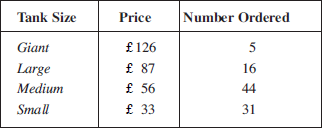
A factory produces plastic tanks in 4 different sizes.
The table opposite shows the orders placed one day.
Find the value of the orders, using the memory keys on your calculator.
1. First press to clear the memory.
2. For the Giant tanks, the value of the order is given by 126 × 5. Find this on your calculator and press the key.
3. For the Large tanks, find 87 ×16 and press again.
4. For the Medium tanks, find 56 × 44 and press again.
5. For the Small tanks, find 33 × 31 and press again.
6. Finally press to obtain the total, which is £5509.
Exercises

Investigation
Within 4 consecutive years, Mrs Morton gave birth to four lovely children. Today, x years later, Mr and Mrs Morton find out that the product of their four children's ages is 3024.How old is each child now, assuming that all the children are of different ages?
Investigation
In his will, a man left 23 cows to his three children. The eldest child was to have half of the herd, the second child should have one third and the youngest one eighth. The children could not decide how to divide up the cows without it being necessary to kill any of them.A wise man came to the scene. He brought along his only cow and put it with the other 23 cows to give a total of 24 cows. He gave half of the 24 cows (12) to the eldest child, one third of the 24 cows (8) to the second child and one eighth of the 24 cows to the youngest child. He then took his own cow back. What is wrong with this solution?
Investigation
In country X, only 5 cent and 8 cent stamps are available. You have to post letters which cost 23 cents, 27 cents, 77 cents and $19.51 respectively. Which of these amounts can you make exactly?Make a complete list of the amounts between 1 cent and 99 cents which cannot be made exactly.