
In this section we consider how to add and subtract fractions. The key step in this process is to make sure that both fractions have the same denominator.
Worked Examples
Calculate:
+
Show meAs the denominator is the same in both fractions, we simply add the numbers on the top of the fraction to give
| + | = |
| = |
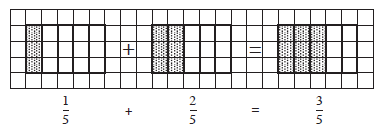
This addition is shown in the diagram below:
−
Show meThe denominator is the same in both fractions, so
| − | = |
| = | |
| = |
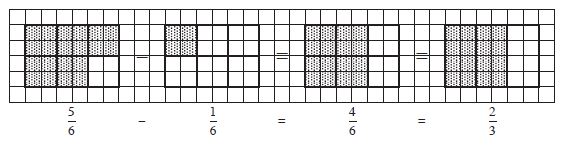
This is shown in the diagram below:
Calculate:
+
Show meThese fractions do not have the same denominator, so the first step is to change them so that they do. In this case, we can use 20 as the common denominator.
| + | = + |
| = | |
| = |
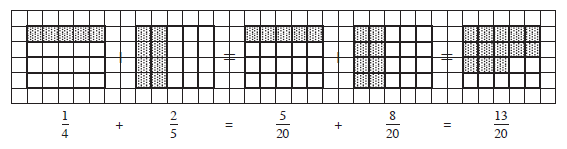
This is illustrated in the diagram below:
−
Show meThe denominator is not the same in both fractions, so
| − | = − |
| = | |
| = |
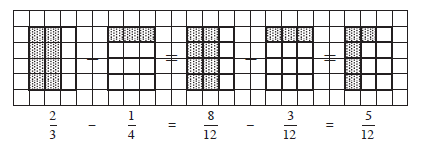
This is illustrated in the diagram below:
Calculate:
+
Show me1 + 3 = 4
| + | = + |
| = | |
| = | |
| So | + = |
−
Show me| − | = − |
| = − | |
| = | |
| = | |
| = |
Note: It is usually easier to convert the mixed numbers into improper fractions.
+
Show me| + | = + |
| = + | |
| = | |
| = | |
| = |
Exercises
