
Units of Measurement 1
Units and Measuring
Different units can be used to measure the same quantities. It is important to use sensible units. Some important units are listed below.
1 km = 1000 m
1 m = 100 cm
1 m = 1000 mm
1 cm = 10 mm
1 tonne = 1000 kg
1 kg = 1000 g
1 litre = 1000 ml
1 m3 = 1000 litres
1 cm3 = 1 ml
Worked Examples
1
What would be the best units to use when measuring,
(a)
the distance between London and Plymouth,
Show me Use km (or miles).(b)
the width of a watchface,
Show me Use mm or cm.(c)
the mass of a person,
Show me Use kg.(d)
the mass of a letter,
Show me Use grams.(e)
the mass of a lorry,
Show me Use tonnes.(f)
the volume of medicine in a spoon,
Show me Use ml.(g)
the volume of water in a swimming pool?
Show me Use m3.2
(a)
How many mm are there in 3.72 m?
Show me| 1 m | = 1000 mm |
| So | |
| 3.72 m | = 3.72 × 1000 |
| = 3720mm |
(b)
How many cm are there in 4.23 m?
Show me| 1 m | = 100 cm |
| So | |
| 4.23m | = 4.23 × 100 |
| = 423cm |
(c)
How many m are there in 102.5 km?
Show me| 1 km | = 1000 m |
| So | |
| 102.5 km | = 102.5 × 1000 |
| = 102 500m |
(d)
How many kg are there in 4.32 tonnes?
Show me| 1 tonne | = 1000 kg |
| So | |
| 4.32 km | = 4.32 × 1000 |
| = 4320 kg |
3
What value does each arrow point to?
(a)
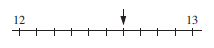
So the arrow points to 12.6.
(b)
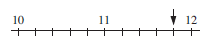
So the arrow points to 11.8.
(c)
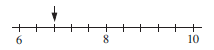
So the arrow points to 6.8.
Exercises
