Example 1
If a = 6, b = –5, c = –7 and d = 3, calculate:
(a)
a + c

| a + c | = 6 + (-7) |
| = 6 - 7 | |
| = -1 |
(b)
a - b
| a - b | = 6 - (-5) |
| = 6 + 5 | |
| = 11 |
(c)
bc
| bc | = (-5) × (-7) |
| = 35 |
(d)
b^2 + cd
| b^2 + cd | = (-5)^2 + (-7) × 3 |
| = 25 + (-21) | |
| = 25 - 21 | |
| = 4 |
Example 2
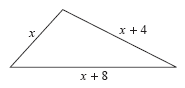
A triangle has sides of length x, x + 4 and x + 8, as shown in the diagram.
(a)
Write down a formula for the perimeter, p, of the triangle.
| p | = x + (x + 4) + (x + 8) |
| p | = 3x + 12 |
(b)
Calculate the perimeter when x = 10.
| p | = 3 × 10 + 12 |
| p | = 30 + 12 |
| p | = 42 |
(c)
Calculate x when the perimeter is 45.
| 45 | = 3x + 12 | |
| 33 | = 3x | Subtracting 12 from both sides |
| x | = | Dividing both sides by 3 |
| x | = 11 |
Example 3
A removal firm charges £80 plus £2 for every mile that their removal van travels.
(a)
Write down a formula for the cost, £C, of a move of n miles.
C = 80 + 2n
(b)
Calculate the cost of moving 262 miles.
| C | = 80 + 262 × 2 |
| C | = 80 + 524 |
| C | = £604 |
(c)
A move costs £500. How far did the removal van travel?
| 500 | = 80 + 2n | |
| 420 | = 2n | Subtracting 80 from both sides |
| n | = | Dividing both sides by 2 |
| n | = 210 miles, so the van travelled 210 miles. | |
Exercises
Note: To type indeces on this page use ^ sign. e.g. n2: 