Example 1

In the diagram opposite, determine the size of each of the unknown angles.
 Since
Since
| c + 180° | = 180° (BCD is a straight line) |
| c | = 180° – 100° |
| c | = 80° |
a + b + c = 180° (angles in a triangle add up to 180°)
then
| a | = 180° – (80° + 80°) |
| so a | = 20° |
Example 2
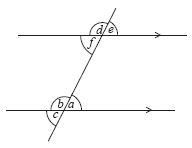
In the diagram opposite, given that a = 65°, determine the size of each of the unknown angles.
| b = 180° – a | (angles on a straight line are supplementary, i.e. they add up to 180°) |
| b = 180° – 65° | |
| b = 115° | |
| c = a = 65° | (vertically opposite angles) |
| d = b = 115° | (corresponding angles, as the lines are parallel) |
| e = a = 65° | (corresponding angles) |
| f = a = 65° | (alternate angles) |
Example 3

Draw an accurate plan of the car park which is sketched here. Use the scale
1 cm ≡ 10 m.
Estimate the distance AB.
The equivalent lengths are:
100 m ≡ 10 cm, 80 m ≡ 8 cm, 60 m ≡ 6 cm,
giving the following scale drawing:
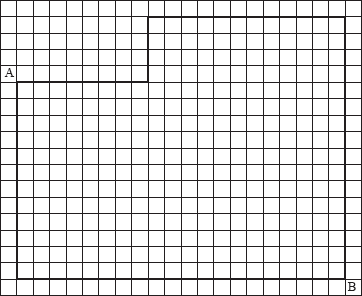
In the scale drawing, AB = 11.7 cm, which gives an actual distance AB = 117 m in the car park.