In this section we look at how to solve linear inequalities and illustrate their solutions using a number line.
When using a number line, a small solid circle is used for ≤ or ≥ and a hollow circle is used for > or <.
For example,
x ≥ 5

Here the solid circle means that the value 5 is included.
x < 7

Here the hollow circle means that the value 7 is not included.
When solving linear inequalities we use the same techniques as those used for solving linear equations. The important exception to this is that when multiplying or dividing by a negative number, you must reverse the direction of the inequality. However, in practice, it is best to try to avoid doing this.
Solve the inequality x + 6 > 3 and illustrate the solution on a number line.
| x + 6 | > 3 | |
| x | > 3 – 6 | Subtracting 6 from both sides of the inequality |
| x | > –3 |
This can be illustrated as shown below:
Solve the inequality 3x + 7 ≥ 19 and illustrate the solution on a number line.
| 3x + 7 | ≥ 19 | |
| 3x | ≥ 12 | Subtracting 7 from both sides |
| x | ≥ 4 | Dividing both sides by 3 |
This can now be shown on a number line.
Illustrate the solution to the inequality 12 – 3x ≥ 6.
Because this inequality contains the term ' –3x ', first add 3x to both sides to remove the – sign.
| 12 – 3x | ≥ 6 | |
| 12 | ≥ 6 + 3x | Adding 3x to both sides |
| 6 | ≥ 3x | Subtracting 6 from both sides |
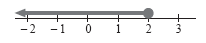
| 2 | ≥ x | Dividing both sides by 3 |
| or x | ≤ 2 |
This is illustrated below.
Solve the equation –7 < 5x + 3 ≤ 23.
In an inequality of this type you must apply the same operation to each of the 3 parts.
| –7 < | 5x + 3 | ≤ 23 | |
| –10 < | 5x | ≤ 20 | Subtracting 3 from both sides |
| –2 < | x | ≤ 4 | Dividing both sides by 5 |
This can then be illustrated as below.