Pythagoras' Theorem describes the important relationship between the lengths of the sides of a right-angled triangle.
Pythagoras' Theorem
In a right-angled triangle,
a2 + b2 = c2
The longest side, c, in a right-angled triangle is called the hypotenuse.
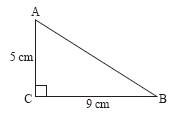
Calculate the length of the side AB of this triangle:
| AB2 | = AC2 + BC2 |
| = 52 + 92 | |
| = 25 + 81 | |
| = 106 |
| AB | = = 10.29563014 cm |
| = 10.3 cm (to 1 decimal place) |
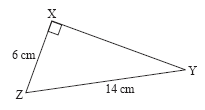
Calculate the length of the side XY of this triangle.
| YZ2 | = XY2 + XZ2 |
| 142 | = XY2 + 62 |
| 196 | = XY2 + 36 |
| XY2 | = 160 |
| XY | = = 12.64911064 cm |
| = 12.6 cm (to 1 decimal place) |
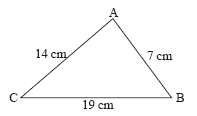
Determine whether or not this triangle contains a right angle.
If the triangle does contain a right angle, then the longest side, BC, would be the hypotenuse.
So, the triangle will be right-angled if AB2 + AC2 = BC2.
| AB2 + AC2 | = 72 + 142 = 49 + 196 |
| = 245 |
| BC2 | = 192 |
| = 361 |
AB2 + AC2 ≠ BC2
so it does not contain a right angle.