Example 1
Factorise:
12x + 8

12x + 8 = 4(3x + 2)
x^3 + x^2
x^3 + x^2 = x^2 (x + 1)
3x^2 + 15x
3x^2 + 15x = 3x(x + 5)
Example 2
Factorise:
As both expressions contain x^2, they will factorise in the form:
(x ± )(x ± )
We must determine the missing numbers, and whether a ' +' or a '–' sign is required in each bracket.
x^2 + 6x + 8
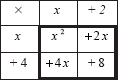
For x^2 + 6x + 8 we require two numbers that multiply together to give 8 and add together to give 6.
So the numbers are 2 and 4.
Hence x^2 + 6x + 8 = (x + 2)(x + 4).
x^2 - 5x + 6
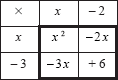
For x^2 - 5x + 6 we require two numbers that multiply together to give 6 and add together to give –5.
So the numbers are –2 and –3.
Hence x^2 - 5x + 6 = (x - 2)(x - 3).
Example 3
Use factorisation to solve the following equations:
x^2 + 6x = 0
First factorise the quadratic expression
x^2 + 6x = 0
x(x + 6) = 0
For the left-hand-side to be zero, either:
x = 0 or x + 6 = 0
The second equation has solution x = -6, so the equation x^2 + 6x = 0 has solution x = 0 or x = -6.
x^2 + 3x + 2 = 0
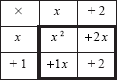
First factorise the left-hand-side of the equation:
x^2 + 3x + 2 = 0
(x + 2)(x + 1) = 0
x + 2 = 0 or x + 1 = 0
so the equation x^2 + 3x + 2 = 0 has solution
x = -2 or x = -1
x^2 - 8x + 16 = 0
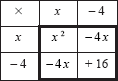
Factorise the left-hand-side of the equation:
x^2 - 8x + 16 = 0
(x - 4)(x - 4) = 0
(x - 4)^2 = 0
So x - 4 = 0
which means that the equation x^2 - 8x + 16 = 0 has just one solution, namely
x = 4
Note that in this example the equation has only one solution.
Example 4
Solve the following equations:
2x^2 = 3x
First, we rearrange the equation so that it has 0 on the right-hand-side.
This first step is essential.
2x^2 = 3x
2x^2 - 3x = 0 Subtracting 3x from both sides
Now we factorise the left-hand-side and solve the equation as we did in Example 2.
x(2x - 3) = 0
so x = 0 or 2x - 3 = 0.
The second equation has solution x = 1.
Therefore the equation 2x^2 = 3x has solution x = 0 or x = 1.
x^2 = 7x - 6
Again, the first step is to rearrange the equation so that it has 0 on the righthand-side.
x^2 = 7x - 6
x^2 - 7x + 6 = 0 Subtracting 7x from both sides and adding 6 to both sides
Now we factorise the left-hand-side and solve the equation.
(x - 1)(x - 6) = 0
so x - 1 = 0 or x - 6 = 0.
Therefore the equation x^2 = 7x - 6 has solution x = 1 or x = 6.
