Unit 3 Section 1 : Index Notation
Here we revise the use of index notation. You will already be familiar with the notation for squares and cubes
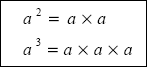
this is generalised by defining:

Here we revise the use of index notation. You will already be familiar with the notation for squares and cubes
this is generalised by defining:
Calculate the value of:
| (a) | 52 |  |
| (b) | 25 | |
| (c) | 33 | |
| (d) | 104 | |
Fill in the missing number or numbers:
| (a) | 2 = 2 × 2 × 2 × 2 × 2 × 2 × 2 | |
| (b) | 9 = 3 | |
| (c) | 1000 = 10 | |
| (d) | 53 = × × | |
| (a) | Determine 25. | |
| (b) | Determine 23. | |
| (c) | Determine 25 ÷ 23. | |
| (d) | Express your answer to (c) in index notation. | |