Example 1
On a set of coordinate axes, plot the points
A (2, 3), B (0, 4), C (–2, 3), D (–1, –2), E (–3, 0), F (2, –4)

The x-axis and the y-axis cross at the origin, (0, 0).
To locate the point A (2, 3), go 2 units horizontally from the origin in the positive x-direction and then 3 units vertically in the positive y-direction, as shown in the diagram.
To locate the point A (2, 3), go 2 units horizontally from the origin in the positive x-direction and then 3 units vertically in the positive y-direction, as shown in the diagram.
Example 2
Identify the coordinates of the points A, B, C, D, E, F, G and H shown on the following grid:
| A (3, 1) |
| B (0, 2) |
| C (–2, 2) |
| D (–3, 0) |
| E (–2, –4) |
| F (0, –2) |
| G (2, –3) |
| H (2, 0) |
Example 3
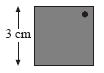
| Marc has ten square tiles like this: |  |
| He starts his row like this: | 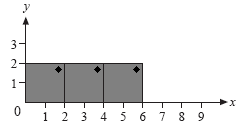 |
 .
. The coordinates of the first corner are (2, 2).
| (a) | Write down the coordinates of the next five corners which have a . | ||
|---|---|---|---|
| |||
| (b) | Look at the numbers in the coordinates. Describe two things you notice. | ||
| |||
| (c) | Marc thinks that (17, 2) are the coordinates of one of the corners which have a . Explain why he is wrong. | ||
| |||
| (d) |
| ||
| She places them next to each other in a row, like Marc's tiles. Write down the coordinates of the first two corners which have a  . . | |||
| |||