
Suppose you take part in a sponsored walk. In the first hour you walk 3 miles, in the second hour 2 miles and in each succeeding hour of the distance the hour before. How far would you walk in 10 hours? How far would you go if you kept on like this for ever?
This gives a sequence of numbers: 3, 2, 1 , etc. This unit is about how to tackle problems that involve sequences like this and gives further examples of where they might arise. It also examines sequences and series in general, quick methods of writing them down, and techniques for investigating their behaviour.

Legend has it that the inventor of the game called chess was told to name his own reward. His reply was along these lines:
"Imagine a chessboard.
Suppose 1 grain of corn is placed on the first square,
2 grains on the second,
4 grains on the third,
8 grains on the fourth,
and so on, doubling each time up to and including the 64th square. I would like as many grains of corn as the chessboard now carries."
It took his patron a little time to appreciate the enormity of this request, but not as long as the inventor would have taken to use up all the corn.
Worked Examples
How many grains would there be on the 64th square?
Show me 1 + 2 + 2^2 + 2^3 + ... + 2^{63}How many would there be on the nth square?
Show me 1 + 2 + 2^2 + ... + 2^{n - 1}Work out the numerical values of the first 10 terms of the sequence.
2^0,\ 2^0+2^1,\ 2^0+2^1+2^2, etc.
Show me 1, 3, 7, 15, 31, 63, 127, 255, 511, 1023How many grains are there on the chessboard?
Show meNoting that the total number on the first 10 squares is
511 + 512 = 2^9 + (2^9 - 1) = 2 × 2^9 - 1 = 2^{10} - 1
the total number on all 64 squares is
2^{64} - 1 ≈ 1.8 × 10^{19}
The series of numbers 1, 2, 4, 8, 16 ... is an example of a geometric sequence, sometimes called a geometric progression (GP). Each term in the progression is found by multiplying the previous number by 2.
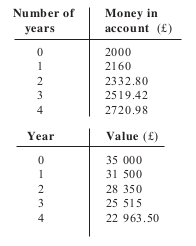
Such sequences occur in many situations; the multiplying factor does not have to be 2. For example, if you invested £2000 in an account with a fixed interest rate of 8% p.a. then the amounts of money in the account after 1 year, 2 years, 3 years etc. would be as shown in the table. The first number in the sequence is 2000 and each successive number is found by multiplying by 1.08 each time.
Accountants often work out the residual value of a piece of equipment by assuming a fixed depreciation rate. Suppose a piece of equipment was originally worth £35 000 and depreciates in value by 10% each year. Then the values at the beginning of each succeeding year are as shown in the table opposite. Notice that they too form a geometric progression
The chessboard problem in the previous section involved adding up
2^0 + 2^1 + 2^2 + ... + 2^{63}
The sum of several terms of a sequence is called a series. Hence the sum 2^0 + 2^1 + 2^2 + ... + 2^{63} is called a geometric series.
Work out the values of
3^0,\ 3^0 + 3^1,\ 3^0 + 3^1 + 3^2,\ 3^0 + 3^1 + 3^2 + 3^3
Show me1, 4, 13, 40
Find a formula for
1 + 3 + 3^2 + ... + 3^{n - 1}
Show meNote that (using the form in Worked Example 1 above),
3^1 - 1 = 2,\ 3^2 - 1 = 8,\ 3^3 - 1 = 26,\ 3^4 - 1 = 80
and comparing this sequence, 2, 8, 26, 80 with (a), we see that
1+3+3^2+...+3^{n - 1}=\frac{3^n - 1}{2}
Find a formula for
1 + 4 + 4^2 + ... + 4^{n - 1}
Show meUsing the method above, the sequence is
1, 5, 21, 85, ...
whilst 4^{n - 1} gives the sequence
3, 15, 63, 255, ...
and each term is 3 times the original sequence.
Hence
1 + 4 + 4^2 + ... + 4^{n - 1} = \frac{4^n - 1}{3}
The general form of a geometric sequence with n terms is
The ratio r of consecutive terms, is known as the common ratio. Notice that the nth term of the sequence is ar^{n - 1}.
In the chessboard problem the solution involved adding up the first 64 terms. The sum of the first n terms of a series is often denoted by Sn, and there is a formula for Sn which you may have found in Worked Example 2. Here is a way of proving the formula, when r ≠ 1.
S_n = a + ar + ar^2 + ... + ar^{n - 1}(1)
Multiply both sides by r :
rS_n = ar + ar^2 + ... + ar^{n - 1} + ar^n(2)
Notice that the expressions for Sn and rSn are identical, with the exception of the terms a and arn . Subtracting equation (1) from equation (2) gives
rS_n - S_n = ar^n - a
⇒ S_n(r - 1) = a(r^n - 1)
If r < 1, it is easier to write
Find
4 + 6 + 9 + ... + 4 × ( 1.5 )^{10}
Show meFirst term a = 4, common ratio r = 1.5 and number of terms n = 11 ;
S_{11}=\frac{4\left(1.5^{11}-1\right)}{1.5-1}=684.0 to 4 s.f.
8 + 6 + 4.5 + ... + 8 × ( 0.75)^{25}
Show meFirst term a = 8, common ratio r = 0.75 and number of terms n = 26 ;
S_{26}=\frac{8\left(1-0.75^{26}\right)}{1-0.75}=31.98 to 4 s.f.

A plant grows 1.67 cm in its first week. Each subsequent week it grows by 4% more than in the previous week. How much does it grow in total in the first nine weeks?
The growths in the first 9 weeks are as follows:
1.67,\ 1.67 × 1.04,\ 1.67 × 1.04^2, ...
Total growth in first nine weeks is
S_9=\frac{1.67\left(1.04^9-1\right)}{1.04-1}=17.67\text{cm} to 4 s.f.
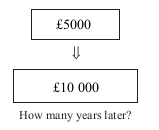
After how many complete years will a starting capital of £5000 first exceed £10 000 if it grows at 6% per annum?
After n years, the capital sum has grown to
5000 × (1.06)^n
When is this first greater than 10 000, n being a natural number? In other words, the smallest value of n is required so that
5000 × (1.06)^n > 10 000,\ n ∈ \N
⇒(1.06)^n > 2
You can either use your calculator to find the value of n, or use logs if you are familiar with this concept. Now take logs of both sides
n ln 1.06 > ln 2
⇒n > \frac{ln 2}{ln 1.06}
⇒n > 11.9
After 12 years, the investment has doubled in value.
Check:
5000 × (1.06)^{11} = 9481.49
5000 × (1.06)^{12} = 10 000.98
Exercises
