
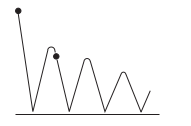
Many of the ideas used so far to illustrate geometric series have been to do with money. Here is one example that is not. If you drop a tennis ball, or any elastic object, onto a horizontal floor it will bounce back up part of the way. If left to its own devices it will continue to bounce, the height of the bounces decreasing each time.
The ratio between the heights of consecutive bounces is constant, hence these heights follow a geometric progression. The same thing is true of the times between bounces.
Worked Examples
A tennis ball is dropped from a height of 1 metre onto a concrete floor. After its first bounce, it rises to a height of 49 cm. Call the height after the nth bounce hn . Find a formula for hn and say what happens to hn as n gets larger.
Show meThe sequence, working in metres, is
1, 0.49, (0.49)2, (0.49)3, ....
Hence, working in cm,
h_n = 100 (0. 49)^n
As n → ∞, hn → 0.
Under these circumstances the time between the first and second bounces is 0.6321 seconds. Call this t1. The next time, t2 , is 0.7t1, and each successive time is 0.7 times the previous one. Find a formula for tn .
Show met_n = (0.7)^{n-1}0.6321
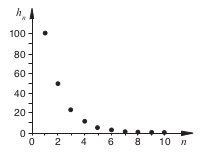
Worked Example 1 gave an example of a convergent sequence. Convergence, in this context, means that the further along the sequence you go, the closer you get to a specific value. For example, in part (a) the sequence to the nearest 0.1 cm is
100, 49.0, 24.0, 11.8, 5.8, 2.8, 1.4, ...
and the numbers get closer and closer to zero. Zero is said to be the limit of the sequence.
The series 1, 2, 4, 8 ...... is a divergent sequence. It grows without limit as the number of terms increases. The same is true, in a slightly different sense, of the sequence 1, −2, 4, −8 .... Any sequence that does not converge is said to be divergent.
For each of these sequences,
(i) write a formula for the nth term;
(ii) find whether the sequence converges;
(iii) find whether the sum Sn converges.
6, 2, , , ...
Show me(i) As each term is of the previous term, the nth term = \frac{6}{3^{n-1}}.
(Check: , , , ,... ⇒ 6, 2, , , ...)
(ii) nth term → 0 as n → ∞ so the sequence converges.
(iii) The sum, Sn , will also converge (to 9, see below).
1, 1.5, 2.25, 3.375, ...
Show me(i) Here each term is 1.5 times the previous term, so
nth term = 1.5n − 1
(Check: 1.50, 1.51, 1.52, ... ⇒ 1, 1.5, 2.25, ...)
(ii) This diverges as n → ∞ .
(iii) Clearly the sum, Sn, also diverges.
4, –3, , – ...
Show me(i) Here each term is \left(-\frac{3}{4}\right) times the previous term, giving
nth term = 4\left(-\frac{3}{4}\right)^{n-1}
(ii) nth term → 0 as n → ∞, so it converges.
(iii) The sum, Sn, also converges ( to , see below)
S_n = \frac{a(1 - r^n)}{(1 - r)}
If r^n → 0 as n → ∞, then S_n → \frac{a}{(1 - r)} as this is the sum of all the terms in the series.
The common ratio, r, is such that when |r| < 1, then r^n → ∞. Hence we have the following important result.
A geometric series, a + ar + ar^2 + ... + ar^{n-1} convergeswhen |r| < 1; i.e. for -1 < r < 1. Since if |r| < 1, r^n → 0 as n → ∞ and
The limit \frac{a}{1-r} is known as the 'sum to infinity' and is denoted S_∞.
Find
8 + 4 + 2 + 1 + ...
Show meThis is a geometric series with first term 8 and common ratio , so
S_∞ = \frac{8}{1 - \frac{1}{2}} = 16
20 − 16 + 12.8 − 10.24 + ...
Show meThis is a geometric series with first term 20 and common ratio −0.8, so
S_∞ = \frac{20}{1-(-0.8)} = \frac{20}{1.8} = \frac{100}{9} = 11.1 (to 3s.f.)
Exercises
