
Geometric sequences involve a constant ratio between consecutive terms. Another important type of sequence involves a constant difference between consecutive terms; such a sequence is called an arithmetic sequence.
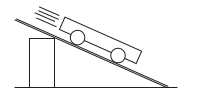
In an experiment to measure the descent of a trolley rolling down a slope a 'tickertape timer' is used to measure the distance travelled in each second. The results are shown in the table on the next page.

The sequence 3, 5, 7, 9, 11, 13 is an example of an arithmetic sequence. The sequence starts with 3 and thereafter each term is 2 more than the previous one. The difference of 2 is known as the common difference.
It would be useful to find the total distance travelled in the first 6 seconds by adding the numbers together. A quick numerical trick for doing this is to imagine writing the numbers out twice, once forwards once backwards, as shown below
| 3 | 5 | 7 | 9 | 11 | 13 |
| 13 | 11 | 9 | 7 | 5 | 3 |
Each pair of vertical numbers adds up to 16. So adding the two sequences, you have 6 × 16 between them. Hence the sum of the original series is
\frac{1}{2}×(6×16)=48
The sum of terms of an arithmetic sequence is called an arithmetic series or progression, often called AP for short.
Worked Examples
Use the example above of a trolley rolling down a slope to answer these questions.
Work out the distance travelled in the 20th second.
Show meThe sequence is
3, 5, 7, 9, 11, 13, 15, 17, 19, 21, 23, 25, 27, 29, 31, 33, 35, 37, 39, 41
and the 20th term is 41.
Calculate S20, the distance travelled in the first 20 seconds, using the above method.
Show meThe distance travelled in 20 seconds can be found by rewriting the sequence as
| 3 | 5 | 7 | 9 | 11 | 13 | 15 | 17 | 19 | 21 |
| 41 | 39 | 37 | 35 | 33 | 31 | 29 | 27 | 25 | 23 |
Each pair of the vertical numbers adds to 44 and there are 10 pairs.
S20 = 10 × 44 = 440 cm
What is the distance travelled in the nth second.
Show meDistance travelled in nth second is (2n + 1) cm.
Show that the trolley travels a distance of n(n + 2) cm in the first n seconds.
Show meTotal distance travelled in n seconds can be found in the same way.
| 3 | 5 | 7 | 9 | 11 | ... |
| 2n + 1 | 2n - 1 | 2n - 3 | 2n - 5 | 2n - 7 | ... |
Each pair now adds up to 2n + 4 and there are \frac{n}{2} pairs.
Thus
| S_n | = \frac{n}{2} × (3 + (2n + 1)) |
| = \frac{n}{2} × (2n + 4) | |
| = n(n + 2) |
Consider the arithmetic sequence 8, 12, 16, 20 ...
Find expressions
for un, (the nth term).
Show meIn this AP the first term is 8 and the common difference 4.
u_1 = 8
u_2 = 8 + 4
u_3 = 8 + 2 * 4
u_4 = 8 + 3 * 4 etc.
un is obtained by adding on the common difference (n − 1) times.
| ⇒ | un | = 8 + 4(n - 1) |
| = 4n + 4 |
for Sn
Show meTo find Sn , follow the procedure explained previously:
| 8 | 12 | ... | 4n | 4n + 4 |
| 4n + 4 | 4n | ... | 12 | 8 |
Each pair adds up to 4n + 12 There are n pairs.
| So | 2Sn | = n(4n + 12) |
| = 4n(n + 3) | ||
| giving | Sn | = 2n(n + 3) |
The general arithmetic sequence is often denoted by
To sum the series of the first n terms of the sequence,
S_n = a + (a + d) + (a + 2d) + ... + (a + (n - 1)d )
Note that the order can be reversed to give
S_n = (a + (n - 1)d) + (a + (n - 2)d) + ... + a
Adding the two expressions for S_n gives
| 2S_n | = (2a + (n - 1)d) + (2a + (n - 1)d) + ... + (2a + (n - 1)d) |
| = n\left[2a + (n - 1)d\right] |
So
An alternative form for S_n is given in terms of its first and last term, a and l, where
l = a + (n - 1)d
since the nth term of the sequence is given by
u_n = a + (n - 1)d
Thus
S_n = \frac{n}{2}(a + l)
This is an arithmetic sequence with first term 5 and common difference 4; so.
S_{20} = \frac{20}{2}(2 × 5 + 19 × 4) = 860
This is an arithmetic sequence with first term 1 and common difference 7. Let the number of terms in the sequence be n.
S_n = 396
⇒\frac{n}{2}(2 + 7( n - 1)) = 396
⇒n(7n - 5) = 792
⇒7n^2-5n-792=0
⇒(7n + 72) (n - 11) = 0
⇒n = 11 since − is not an integer.
The number of terms is 11.
Exercises
