
Solving Linear Inequalities
Solution of Linear Inequalities (Inequations)

Inequalities such as 6x − 7 ≤ 5 can be simplified before solving them. The process is similar to that used to solve equations.

Worked Examples

1

Solve the inequality

6x − 7 ≤ 5

and illustrate the result on a number line.

Show me

Begin with the inequality

6x − 7 ≤ 5

Adding 7 to both sides gives

6x ≤ 12

Dividing both sides by 6 gives

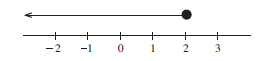
x ≤ 2

This is represented on the number line below.
2

Solve the inequality

4(x − 2) > 20

Show me

Begin with the inequality

4(x − 2) > 20

First divide both sides of the inequality by 4 to give

x − 2 > 5

Then adding 2 to both sides of the inequality gives x > 7.

3

Solve the inequality

5 − 6x ≥ −19

Show me

Begin with the inequality

5 − 6x ≥ −19

In this case, note that the inequality contains a '−6x' term. The first step here is to add 6x to both sides, giving

5 ≥ −19 + 6x

Now 19 can be added to both sides to give

24 ≥ 6x

Then dividing both sides by 6 gives

4 ≥ x

or

x ≤ 4

4

Solve the inequality

−10 < 6x + 2 ≤ 32

Show me

Begin with the inequality

−10 < 6x + 2 ≤ 32

The same operation must be performed on each part of the inequality. The first step is to subtract 2, which gives

−12 < 6x ≤ 30

Then dividing by 6 gives

−2 < x ≤ 5

The result can then be represented on a number line as shown below.

An alternative approach is to consider the inequality as two separate inequalities:

(1)   −10 < 6x + 2     and     (2)   6x + 2 ≤ 32

These can be solved as shown below.

(1)  −10 < 6x + 2(− 2)
−12 < 6x(÷ 6)
−2 < x
(2)  6x + 2 ≤ 32(− 2)
6x ≤ 30(÷ 6)
x ≤ 5

Both inequalities can then be displayed as shown below.

Where the two lines overlap gives the solution as

Exercises

Solve each inequality below and illustrate the solution on a number line.

(a)
4x + 6 ≤ 18 x
(b)
5x − 8 > 27 x
(c)
6x + 7 < 37 x
(d)
5x − 7 ≥ −17 x
(e)
< 1 x
(f)
4(2x − 3) ≥ −8 x

Solve the following inequalities.

(a)

5x − 6 < 29

x
(b)

7x + 2 ≥ −19

x
(c)

5x − 8 ≤ 12

x
(d)

6x − 3 ≥ 1

x
(e)

5x + 7 < 11

x
(f)

7x − 8 > −2

x
(g)

4 − 2x ≥ −8

x
(h)

5 − 6x < −7

x
(i)

4(2 − x) ≥ −8

x
(j)

7 + 4x ≥ 19

x
(k)

6 − 5x > −10

x
(l)

≥ 3

x

Solve each of the following inequalities and illustrate them on a number line.

(a)
5 < 3x + 2 ≤ 11 x
(b)
3 ≤ 4x − 5 < 15 x
(c)
11 ≤ 4x + 7 < 27 x
(d)
5 < 6x − 7 < 29 x
(e)
−3 ≤ 4x + 5 < 17 x

Clayton owns a barber's shop. It costs him £20 per day to cover his expenses and he charges £4 for every haircut.

(a)
His profit for any day is £, where x is the number of haircuts in that day.

He hopes to make at least £50 profit per day, but does not intend to make more than £120 profit.

(b)

Write down an inequality to describe this situation.

(c)

Solve the inequality.

x

A man finds that his electricity bill varies between £50 and £90.

(a)

If C represents the size of his bill, write down an inequality involving C.

C

The bill is made up of a standing charge of £10 and a cost of 10 pence per kilowatt hour of electricity.

(b)

If n is the number of kilowatt hours used, write down a formula for C in terms of n.

C =
(c)

Using your formula, write down an inequality involving n and solve this inequality.

n
(a)

List all the integers which satisfy

−2 < n ≤ 3

List the numbers separated by commas in increasing order.

(b)

Scott said, "I thought of an integer, multiplied it by 3 then subtracted 2. The answer was between 47 and 62."

List the integers that Scott could have used.

List the numbers separated by commas in increasing order.