
Vectors
Vectors and Geometry

Vectors can be used to solve problems in geometry. In two dimensions, it is possible to describe the position of any point using two vectors. For example, using the vectors a and b shown in the diagram:
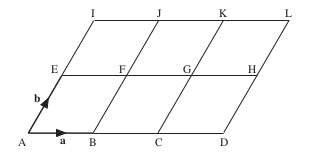
AC = 2a

EF = a

IK = 2a

AF = a + b

AL = 3a + 2b

LE = −3a − b

Note that AB, EF and IK are all parallel vectors as they have the same direction.

Worked Examples

1

In the parallelogram shown below, AB = b and AD = d. Also X is the midpoint of BC and Y lies on DC such that DY = 2CY.
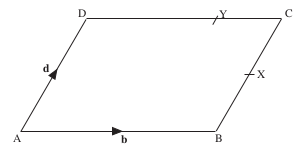
Express the following vectors in terms of b and d.

(a)

AC

Show me
AC = AD + DC
= b + d
(b)

BX

Show me
BX = BC
= d
(c)

AX

Show me
AX = AB + BX
= b + d
(d)

DY

Show me
DY = DC
= b
(e)

AY

Show me
AY = AD + DY
= d + b
(f)

XY

Show me
XY = XA + AY
= −⎛
⎝
b + d⎞
⎠
+ ⎛
⎝
d + b⎞
⎠
= b − b + d − d
= −b + d
2

The diagram shows 2 identical parallelograms. The vector q = AF and the vector p = AB. The point M is the midpoint of CD.
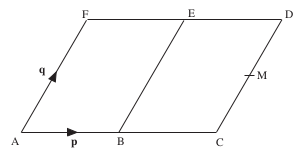
(a)

Show that BM is parallel to AD.

Show me
BM = BC + CM
= p + q
AD = AC + CD
= 2p + q

As AD = 2BM, the lines AD and BM must be parallel.

(b)

Show that EM is parallel to FC.

Show me
EM = ED + DM
= p + ⎛
⎝
−q⎞
⎠
= p − q
FC = FD + DC
= 2p − q

As FC = 2EM, the lines FC and EM must be parallel.
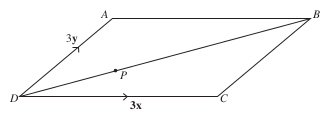
3

In the figure above, not drawn to scale, ABCD is a parallelogram such that DC = 3x and DA = 3y. The point P is on DB such that DP : PB = 1:2.

(a)

Express in terms of x and y.

(i)
AB Show me = DC = 3x
(ii)
BD Show me = BA + AD = −3x − 3y = −3(x + y)
(iii)
DP Show me = DB = −BD = −(−3)(x + y) = x + y
(b)

Show that AP = x − 2y.

Show me AP = AD + DP = −3y + (x + y) = x − 2y
(c)

Given that E is the mid-point of DC, prove that A, P and E are collinear.

Show me

DE = x, so PE = PD + DE = −x − y + x = x − y

Hence

2 × PE = x − 2y = AP

that is PE and AP have the same direction. So A, P and E are collinear.

(d)

Given that x = and y = , use a vector method to prove that triangle AED is isosceles.

Show me

We need to find two sides of equal length.

Now

DE = x = =

and

DE = = = = 3

AE = AD + DE = −3y + x = −3 +

= +

=

So

AE = √02 + (−3)2 = = = 3

As AE = DE = 3, triangle ADE is isosceles.

Exercises

The diagram shows a grid made up of sets of equally spaced parallel lines. The vectors OA = a and OE = b are shown on the grid.

Write each of the following vectors in terms of a and b.

(a)
OD
(b)
AB
(c)
BG
(d)
IS
(e)
JP
(f)
ES
(g)
AQ
(h)
CS
(i)
PK
(j)
PG
(k)
RF
(l)
SE
(m)
CP
(n)
GE
(o)
IJ
(p)
TA

The diagram shows the parallelogram OABC, in which OA = a and OC = c.

Use decimals if needed.

(a)

Write the following vectors in terms of a and c.

(i)
AB
(ii)
CB
(iii)
BC
(iv)
AC
(v)
OB
(vi)
CA
(b)

If X is the midpoint of AB and Y is the midpoint of BC, find the following in terms of a and c.

(i)
AX
(ii)
OX
(iii)
CY
(iv)
OY
(v)
XY

The diagram shows the parallelogram OPQR; the vectors p = OP and q = OR.

(a)

If M is the midpoint of PR, find OM.

(b)

If N is the midpoint of OQ, find ON.

The diagram shows the rectangle OABC. The vectors i and j are such that OA = 6j and OC = 8i .

(a)

If the point D lies on AB such that AD = 3DB, find AD and OD in terms of i and j.

AD =

OD =

(b)

If E lies on BC such that 2BE = EC, find CE and OE.

CE =

OE =

(c)

The point M is the midpoint of DE. Find OM.

OM =

In the diagram, BCEF is a parallelogram and AB = BC = CD.

The vector p = BF and q = BC. The point M is the midpoint of AF and N is the midpoint of DE.

(a)

Express AM and AN in terms of p and q.

AM =

AN =

(b)

Find MN in terms of p and q.

MN =

The shape in the diagram shows the vectors a, b and c. M is the midpoint of AE.

Find each of the following in terms of a, b and c.

(a)
AE
(b)
AM
(c)
BA
(d)
MD
(e)
CM

OABC is a parallelogram.

OA = 3p − 2q

OC = 5p + 6q

Find AC. Express your answer as simply as possible in terms of p and q.

AC =

OABC is a parallelogram. OA = a, OC = c.

BCE is a straight line, BE = 3BC.

D is the midpoint of OC.

(a)

Write in terms of a and c,

(i)
AD,
(ii)
OE.
(b)

Deduce the ratio of the lengths of AD and OE.

: