
You will be thankful that the Exercises in Section 1 were neither lengthy nor involved powers higher than the 5th power. As the index rises, so the expansions become more tedious. Expanding (1 + x)^{50} by this method, for example, would be somewhat daunting!
Worked Examples
Using your answers to Question 1 in Section 1, complete this table :
| Coefficients of | |||||||||
| 1 | x | x1 | x2 | x3 | x4 | x5 | x6 | x7 | |
| (1 + x)1 | 1 | 1 | |||||||
| (1 + x)2 | 1 | 2 | 1 | ||||||
| (1 + x)3 | 1 | 3 | 3 | 1 | |||||
| (1 + x)4 | |||||||||
| (1 + x)5 | |||||||||
Show me
The extra rows are
| (1 + x)4 | 1 | 4 | 6 | 4 | 1 | |||
| (1 + x)5 | 1 | 5 | 10 | 10 | 5 | 1 |
Describe the pattern in this table.
Show meApart from the initial 1, you add two consecutive terms together; that is, 1 + 4 = 5 , 4 + 6 = 10 , etc.
| (1 + x)6 | 1 | 6 | 15 | 20 | 15 | 6 | 1 | |
| (1 + x)7 | 1 | 7 | 21 | 35 | 35 | 21 | 7 | 1 |
Write out the expansions of (1 + x)6 and (1 + x)7.
What is the sum of the numbers in the nth row?
In a similar way,
(a + x)^5 = ( a + x ) ( a + x ) ( a + x ) ( a + x ) ( a + x )
and the expansion is
a^5 + 5a^4x + 10a^3x^2 + 10a^2 x^3 + 5ax^4 + x^5
In each term the two index numbers add up to 5 (noting that x = x1 , a = a1 ). Moreover, the sum of the coefficients is 32(1 + 5 + 10 + 10 + 5 + 1). These two facts reflect what is going on here: each term is the product of a mixture of 'a's and 'x's, one letter from each of the 5 brackets. Each bracket can supply one of two letters, so the number of different combinations of 'a's and 'x's is 2 × 2 × 2 × 2 × 2 .
Only one such combination is all 'a's, hence the expansion starts with a single a5 term.
Five of the 32 possibilities give a4x (that is, aaaax, aaaxa, aaxaa, axaaa and xaaaa), 10 of them give a3x2 , and so on. It is the general method of finding the binomial coefficients 1, 5, 10, 10, 5, 1 that is being sought. That is the aim of the next section.
Bridge is one of the best of all card games. In particular, it is one in which the skills of the players can overcome the luck of the deal. We use a situation often faced by bridge players in our next Worked Example.
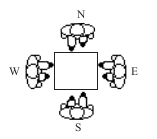 Suppose you are sitting at S (south); your partner is facing
you at N. The opposing players are sitting either side of you
at W (west) and E (east). You know that between them the
opposing players have four cards in the heart suit. It is
important to know the relative likelihood of various
distributions of these four cards between W and E.
Suppose you are sitting at S (south); your partner is facing
you at N. The opposing players are sitting either side of you
at W (west) and E (east). You know that between them the
opposing players have four cards in the heart suit. It is
important to know the relative likelihood of various
distributions of these four cards between W and E.
Each of the four cards can be in one of two places. Hence there are 24 = 16 different arrangements.
How many of these arrangements involve all four hearts being with W and none with E?
Show me 1 (no hearts)How many of them involve E having only one heart?
Show me 4 (could be any of the 4 hearts)Complete the table below.
| W | E | No. of ways |
| 4 | 0 | 1 |
| 3 | 1 | 4 |
| 2 | 2 | 6 |
| 1 | 3 | 4 |
| 0 | 4 | 1 |
| Total 16 |
Bridge players sometimes claim that in these circumstances a '1-3 split' (either way) is more likely than an even split. Is this true? Explain.
Show meThis is true as a 1-3 split or a 3-1 split has probability of while a 2-2 split has probability .
Extend this to the case where S knows that W and E have 5 hearts between them.
Show me| W | E | No. of ways |
| 5 | 0 | 1 |
| 4 | 1 | 5 |
| 3 | 2 | 10 |
| 2 | 3 | 10 |
| 1 | 4 | 5 |
| 0 | 5 | 1 |
| Total 32 |
You should by now have realised that it could be dangerous to play bridge with a mathematician!
Many US cities have a street layout based on a rectangular pattern. On Manhattan Island, for instance, more than 200 streets run across the island and ten avenues run at right angles to them.
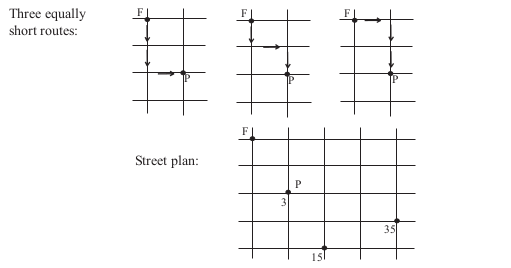
In the following diagrams, F represents a fire station. A fire is reported at junction P and the fire services need to take the shortest route from F to P. In fact, there are three equally short routes, as the three diagrams show.
Copy the street plan shown and, by each crossroad, write the number of shortest routes there are from F. Some have been written in to help you.
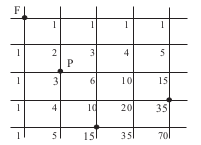
Here is the solution!
The 'bridge' example and the 'Manhattan Island streets' example give the same pattern as that of the binomial coefficients. This is because all three situations can be reduced essentially to the same thing. Here are specific questions and solutions from all three.
Bridge problem
In how many ways can 5 cards be divided so that 3 are with E and 2 with W?
Solution
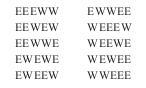
Imagine all five cards in a row. Each can be marked
either E or W. There must be 3 Es and 2 Ws in any order.
The answer to the question is, therefore, the number of
different combinations possible with 3 Es and 2 Ws.
As the list opposite shows, that number is 10.
Streets problem
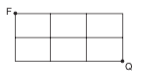
In this plan, how many shortest routes are there from F to Q?
Solution
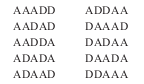
F and Q are 5 blocks away. To get to Q by the shortest
route you must go across (A) 3 and down (D) 2, in any
order. The number of such routes is therefore the number
of different combinations of 3 As and 2 Ds.
The answer is 10.
Binomial coefficients
In the expansion of (a + x)^5, what is the coefficient of the term a^3x^2?Solution
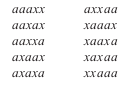
( a + x )^5 is short for ( a + x )( a + x )( a + x )( a + x )( a + x ). To get a^3 x^2 three brackets must supply an ‘a’ and two of them an ‘x’. The coefficient will be the number of ways this can be done. A list of the possible ways is shown on the right.
It should now be clear why three apparently unrelated problems give identical answers. The number of ways of arranging 3 As and 2 Ds is denoted
\binom{5}{3} or 5C3 (= 10)
The ‘C’ stands for COMBINATION.
To take another example.
\binom{7}{2} or 7C2
means the number of different combinations of 7 objects, 2 of one type and 5 of another.
Exercises
