
You are already familiar with the idea of a function. Here we make the concept more formal with a number of definitions that we will introduce. We illustrate the definitions using examples, including the formula that relates pressure to volume:
Here p is the pressure of a gas, v is its volume and k is a constant.
Worked Examples
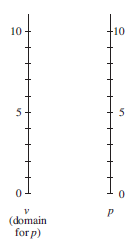
If p = , use the mapping diagram opposite to show how v maps to p for
Clearly if
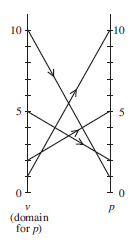
| v = 1, | p = = 10 |
| v = 2, | p = = 5 |
| v = 5, | p = = 2 |
| v = 10, | p = = 1 |
We can illustrate this mapping.
In fact, for any value 1 ≤ v ≤ 10, we can map v to p.
For example,
v = 4, p = = , etc.
Notes
1. The set of values of v, defined here as 1 ≤ v ≤ 10, is called the DOMAIN of the mapping.For the function y = f(x) = x2, −5 ≤ x ≤ 5, complete a similar mapping diagram.
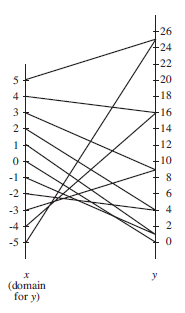
Here, notice that
f(−5) = (−5)2 = 25
f(−2) = (−2)2 = 4
f(0) = 0
f(5) = 25
etc.
We can complete the mapping opposite for some of the values.
Notes
1. In this example, apart from 0 (which maps to 0), there are two values which both map to the same value. For example, +2 and −2 both map to 4. This is NOT a 1 : 1 mapping.f : x → x2
If f is defined by
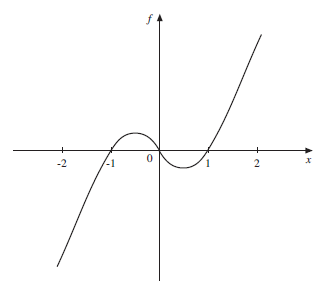
f : x → x3 − x
what are the values of
f(−1)
Show me f(−1) = (−1)3 − (−1) = −1 + 1 = 0f(0)
Show me f(0) = 03 − 0 = 0f(1)
Show me f(1) = 13 − 1 = 1 − 1 = 0f(5) ?
Show me f(5) = 53 − 5 = 125 − 5 = 120Note
This is not a 1 : 1 mapping as f(−1) = f(0) = f(1).
This can be seen in a sketch of the function, as below.
Exercises
