
It may be useful to first revise our knowledge of how integer indices work.
Worked Examples
Complete these general statements:
For any non-zero number x, and any integers m and n:
Expressions like 32, 410 and 10−6, all of which involve powers (or indices), will be familiar. But can any meaning be attached to an expression like 20.6 and if it can, does it have any relevance?
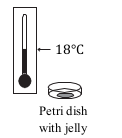
Bacteria perform the roles of friend and foe at the same time. They are micro-organisms that perform a crucial function in nature by causing plant and animal debris to decay in the soil, but at the same time they can cause disease. Under favourable conditions they reproduce freely. Lone bacterium will first split into two bacteria, then these will themselves split into two and so on.
This growth can be observed by placing a lone bacterium onto a petri dish and positioning the dish in a warm environment. The splitting process under these sorts of conditions will take place twice per hour; hence after one hour there will be 4 bacteria, after two hours 16 bacteria and so on.
Complete the table shown. Write a formula for the number of bacteria after t hours.
| Time (hours) | 0 | 1 | 2 | 3 | 4 | ... | t |
| Number of bacteria | 1 | 4 | 16 | 64 | 256 | ... | 4t |
Interpret this formula when t = , 1, 2, 3.
Show meWhen t = Number of bacteria = 4 = 2
When t = 1 Number of bacteria = 4 = 8
When t = 2 Number of bacteria = 4 = 32
When t = 3 Number of bacteria = 4 = 128
Given that 20 = 1, 21 = 2, 22 = 4 and 23 = 8:
Draw an accurate graph of y = 2x by joining together these points with a curve drawn as smoothly as possible.
Show me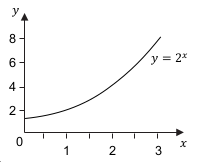
See the graph shown opposite.
The value of 21 must be double that of 2.
Why?
Make a similar statement about 22. Are these statements supported by your graph?
Show meThe value of 21 is double that of 2.
We have seen the value double each time the power increases by 1. The difference between 1 and 2 is indeed 1.
The value of 22 must be double that of 21.
These statements are supported by the graph shown.
What is your interpretation of 2?
Show me2 is half of 21 (as the power has decreased by 1).
Some further logarithmic deductions are highlighted in the next worked example.Let p stand for the value of 2 . What can you say about p2? What rule of indices did you use?
Show mep^2 = 2 (2^{\frac{1}{2}})^2 = 2^1 (x^m)^n = x^{mn}
What is the meaning of x?
Show mex^{\frac{1}{2}} = \sqrt{x}
Suppose q stands for the value of 2. What is q3?
Show meq^3 = 2 (2^{\frac{1}{3}})^3 = 2^1 (x^m)^n = x^{mn}
What does x mean?
Show mex^{\frac{1}{3}} = \sqrt[3]{x}
In general,
x^{\frac{1}{2}} is another way of writing \sqrt{x}
x^{\frac{1}{3}} is another way of writing \sqrt[3]{x}
x^{\frac{1}{n}} is another way of writing \sqrt[n]{x}
This alternative notation is often used on calculators. Your calculator may have a function x^{\frac{1}{y}}. If so, it can be used to find nth roots as follows.
To find \sqrt[10]{2} or 2^{\frac{1}{10}} press
The answer should be 1.071773463.
We explore the nth root further in the worked example below.
Find \sqrt[10]{100} to 3 s.f. without using the x^\frac{1}{y} or \sqrt[x]{\ } function on your calculator. You may use the x^y function.
(Try simpler examples like \sqrt{100} or \sqrt[3]{100} first if you’re not sure how to do this.)
Repeat for \sqrt[100]{1\ 000\ 000\ 000} and \sqrt[10]{0.1}.
\sqrt[10]{100} = 100^{\frac{1}{10}} = 100^{0.1} = 1.5848931...
(\sqrt{100} = 100^{\frac{1}{2}} = 10 \sqrt[3]{100} = 100^{\frac{1}{3}} = 4.6415888... )
\sqrt[100]{1 000 000 000} = 1 000 000 000^{0.01} = 1.23026877... \sqrt[10]{0.1} = 0.1^{0.1} = 0.7943282...
The bacteria problem presented earlier is an example of 'exponential' growth. In this case, the exponential growth is defined as a growth whereby the number of bacteria present is multiplied by 4 every hour.
Exponential growth occurs in many situations and fractional indices are often very useful. A good example concerns credit card accounts where any unpaid debt grows exponentially by a certain percentage each month. Credit cards quote a monthly interest rate and the equivalent APR (annual percentage rate).
A typical APR is 29.84%. This means that a debt of £100 at the start of the year becomes one of £129.84 by the end. However, the interest is worked out monthly at a monthly rate of 2.2%.
This figure arises because
(1.022)^{12} = 1.2984
giving an APR of (1.2984 − 1) × 100%.
Another way of writing this is to say
1.2984^{\frac{1}{12}} = 1.022
What is the monthly interest rate if the APR is 34.45% ?
Since
(1.3445)^{\frac{1}{12}} = 1.02498...,
monthly interest rate = 2.5%.
Joel has an outstanding credit card bill of £162. The APR is 30.23%. He leaves it two months before paying. How much does he have to pay?
2 months is of a year.
But
(1.3023)^{\frac{1}{6}} = 1.045
and
1.045 × 162 = £169.29, the amount Joe has to pay.
Exercises
