
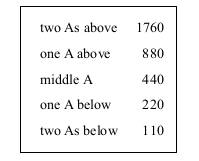
Piano tuners also deal with exponential growth. When tuning a piano to 'concert pitch' the first thing to do is to make sure the note A in the middle of the piano is in tune. A properly tuned ‘middle A’ has a vibrating frequency of 440 Hz (Hz is short for Hertz and means cycles per second).
There are lots of notes called A on the piano. The distance between consecutive As is called an octave. Every octave up, the frequency doubles, as follows:
Worked Examples
Write down a formula for the frequency of the note p octaves above middle A.
Show me 440 × 2^pUse this to find the frequency of the note half an octave above A.
Show me 440 × 2^{\frac{1}{2}} = 622.25 (to 2 d.p.)An octave actually consists of 12 notes, so 'half an octave higher' means '6 notes higher'. Find the frequency of the note
3 notes above middle A
Show me 440 × 2^{\frac{1}{4}} = 523.25 (to 2 d.p.)5 notes above middle A
Show me 440 × 2^{\frac{5}{12}} = 587.33 (to 2 d.p.)6 notes below middle A
Show me 440 × 2^{-\frac{1}{2}} = 311.13 (to 2 d.p.)11 notes below middle A
Show me 440 × 2^{-\frac{11}{12}} = 233.08 (to 2 d.p.)Adapt your formula in (a) to find the frequency of the note n above middle A. Does this formula apply to notes below middle A?
Show me 440 × 2^{\frac{pn}{12}}Yes: p will be either positive (above middle A) or negative (below middle A)
Remembering that (xm)n = xmn, there are always at least two ways of thinking about expressions like 3^{\frac{2}{5}}.
| 3^{\frac{2}{5}} | = (3^2)^{\frac{1}{5}} | or | 3^{\frac{2}{5}} | = \left(3^{\frac{1}{5}}\right)^2 |
| = (\sqrt[5]{3^2}) | = (\sqrt[5]{3})^2 | |||
| = \sqrt[5]{9} |
In general,
| x^{\frac{p}{q}} = \sqrt[q]{x^p} | or | (\sqrt[q]{x})^p |
Since
| \frac{2}{5} = 2\times\frac{1}{5} | or | \frac{2}{5} = \frac{1}{5}\times2 |
the order of the root and the power does not matter.
Note: Look out for the simplest one to do first!
For example:
16^{\frac{3}{4}} = (16^3)^{\frac{1}{4}} or 16^{\frac{3}{4}} = (16^{\frac{1}{4}})^3
In this case it is simpler to find the 4th root of 16 first (i.e. 2) and then cube it (i.e. 8)
16^{\frac{3}{4}} = (16^{\frac{1}{4}})^3 = 8
This extends to negative indices.
Examples are:
3^{-2} = \frac{1}{3^2} = \frac{1}{9}
3^{-\frac{2}{5}} = \frac{1}{3^{\frac{2}{5}}} = \frac{1}{\sqrt[5]{9}}
and
Here is another example:
10^{1.2} = 10^{\frac{6}{5}}
| 10^{\frac{6}{5}} | = (10^6)^\frac{1}{5} | or | 10^{\frac{6}{5}} | = \left(10^{\frac{1}{5}}\right)^6 |
| = (\sqrt[5]{10^6}) | or | = (\sqrt[5]{10})^6 | ||
| = \sqrt[5]{1000000} | or | |||
| = 10(\sqrt[5]{10}) | or |
or
10^{1.2} = 10^1 \times 10^{\frac{1}{5}} = 10(\sqrt[5]{10})
Calculate the numerical values of
(a) 2^{\frac{4}{7}} (b) 10^{\frac{3}{2}} (c) 6^{-\frac{3}{8}} (d) (0.6)^{-\frac{7}{3}}There is always more than one method of working these out. A different method is shown for each one here. Pay particular regard to the methods in (b) and (d).
(a)2^{\frac{4}{7}} = (2^4)^{\frac{1}{7}} = \sqrt[7]{16} = 1.49 to 2 s.f.
(b)10^{\frac{3}{2}} = 10^1 × 10^{\frac{1}{2}} = 10\sqrt{10} = 31.6 to 3 s.f.
| 6^{\frac{3}{8}} = \left(6^{\frac{1}{8}}\right)^3 = (1.251033...)^3 = 1.9579731... |
| 6^{-\frac{3}{8}} = \frac{1}{6^{\frac{3}{8}}} = \frac{1}{1.9579731...} = 0.511 to 3 s.f. |
| (0.6)^{\frac{7}{3}} | = (0.6)^{2\frac{1}{3}} = (0.6)^2 × (0.6)^{\frac{1}{3}} |
| = 0.36 × \sqrt[3]{0.6} = 0.3036358... | |
| (0.6)^{−\frac{7}{3}} | = \frac{1}{0.3036358...} = 3.29 to 3 s.f. |
(Calculator note: always carry through as many figures as you can until the end of the calculation.)
Exercises
