
When designing a questionnaire to use as part of a survey, bear in mind the following guidelines.
- The questionnaire should try to find out the information you need.
- You should know how you are going to collect your responses.
- Questions should be clear and concise with no ambiguity.
- Do not ask for information you do not need.
- Allow for all possible responses.
- Questionnaires should be fair and not biased in any way.
- The people asked to complete the questionnaire should be from a variety of backgrounds.
It should also be noted that if you need to design a questionnaire for any project work, it is strongly recommended that you first try it out with a small number of people. This is called a pilot survey.
Questions can be designed in two distinct ways, namely those that require a specified response to be chosen from a number of options or by giving a number, and those that allow more detailed responses. The first group are often referred to as closed questions; the second as open questions. Here are some examples.
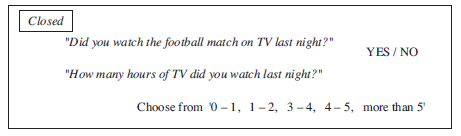
The second example of a closed question shows an example with multiple responses – by which we mean more than 2. So 'YES / NO' is not regarded as a multiple response.
There is though a problem with these responses as there is potential overlap. i.e. in which category do you place 1 hour or 2 hours, etc.? It should be made clear, i.e. 0 – 1 includes everything up to and including 1, etc.

The second example is good for a face to face discussion, as it allows a wide range of answers. The questioner will then be able to react to these answers, and continue the discussion. This example is bad for a questionnaire for the same reason! Any answer is possible but the writer of the questionnaire does not have the chance to follow up answers. It could though be modified and become a closed question with multiple responses: for example,
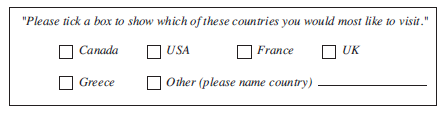
Worked Examples
Consider this questionnaire:
Are you concerned about the environment?
Are you concerned about the level of pollution caused by vehicles?
Do you think the health of young children is at risk due to exhaust fumes from vehicles?
Is there too much traffic congestion in towns?
Is public transport under-used?
Do you think vehicles should be banned from main shopping streets?
Comment on the questions given here.
This questionnaire is very biased and has been designed to lead people towards answering 'yes' to the last question. There are no questions about the advantages of cars, the problems of using public transport or other ways of reducing pollution.
What is wrong with the following survey, used to find the favourite sports of the students in one school?
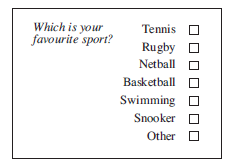
The question used in this survey does not cover all the possible responses well. Many students might have, for example, football as their favourite sport and so would tick the box marked 'Other'. This would give unhelpful results. Also, students are asked to make only one choice although they may well like more than one sport.
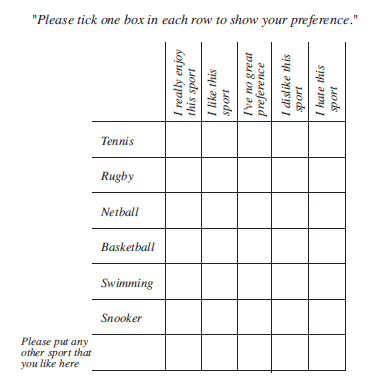
The following wording would produce more useful responses.
Exercises
