
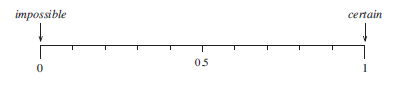
Probabilities are given values between 0 and 1. A probability of 0 means that the event is impossible, while a probability of 1 means that it is certain. The closer the probability of an event is to 1, the more likely it is to happen. The closer the probability of an event is to 0, the less likely it is to happen.
Worked Examples
When you toss a coin, what is the probability that it lands heads up?
When you toss a coin there are two possibilities, that it lands heads up or tails up. As one of these must be obtained,
p(heads) + p(tails) = 1
But both are equally likely so
p(heads) = p(tails) =
The probability that it rains tomorrow is .
What is the probability that is does not rain tomorrow?
Tomorrow it must either rain or not rain, so,
| p(rain) + p(no rain) | = 1 | |
| The probability it rains is , so | ||
| + p(no rain) | = 1 | |
| p(no rain) | = 1 − | |
| = | ||
So the probability that it does not rain is .
Exercises
