
When dealing with probabilities for two events, it is important to be able to identify all the possible outcomes. Here are examples to show the methods that can be used.
Note
Assume that any dice referred to in this unit is 6-sided and fair. Assume that a coin is fair. A pack of cards comprises 52 cards.Worked Examples
Method A : Systematic Listing
For a special meal, customers at a pizza parlour can choose a pizza with one of the following toppings.
Mushroom
Salami
Pepperoni
Tuna
and a drink from the following list
Diet Cola
Orange
How many possible combinations of toppings and drinks are there?
Using the first letter of each drink and topping, it is easy to see that Cola (C)) could be combined with any of the five toppings to give CH, CM, CS, CP, CT. Here 'CH' means 'Cola' drink and 'Ham' topping, etc.
Similarly, for Diet Cola (D), you have
DH, DM, DS, DP, DT
and for Orange (O)
OH, OM, OS, OP, OT
You can see that there are 3 × 5 = 15 possible outcomes.
This method of listing will always work but it might be slow, particularly if there are more than 2 choices to be made.
Method B : 2-way Tables
A die and a coin are tossed. List all the possible outcomes.
The coin can land heads (denoted by H) or tails (T), whilst the die can show 1, 2, 3, 4, 5 or 6. So for heads on the coin, the possible outcomes are
H1, H2, H3, H4, H5 and H6
whilst for tails, they are
T1, T2, T3, T4, T5 and T6.
The listing method used here can be conveniently summarised in a 2-way table.
| Die | |||||||
| 1 | 2 | 3 | 4 | 5 | 6 | ||
| Coin | H | H1 | H2 | H3 | H4 | H5 | H6 |
| T | T1 | T2 | T3 | T4 | T5 | T6 | |
This method works well but cannot be used if there are more than 2 choices to be made.
Method C : Tree Diagrams
A coin is tossed twice. List all the possible outcomes.
You can use a tree diagram to represent this solution.
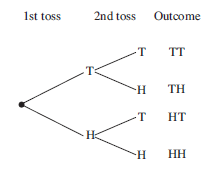
Note that 'TH' is not the same as 'HT'.
This is an excellent method, but can lead to problems if there are too many branches.
Exercises
