
You will have already met this type of distribution in earlier sections of this unit, as well as the concept of random variables.
Worked Examples
Ashoke, Theo and Sadie will each visit the local leisure centre to swim on one evening next week but have made no arrangement between themselves to meet or go on any particular day. The random variable X is 'the number of the three who go to the leisure centre on Wednesday'. Find the probability distribution for X, that is, the probabilities for each value of X.
The probabilities of 0, 1, 2 or 3 people going on Wednesday can be found by using the tree diagram method covered in the unit Probability of Two or More Events.
The following tree diagram shows probabilities for how many go on Wednesday.
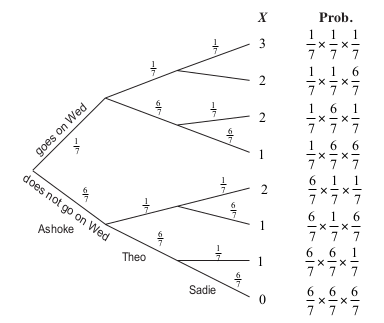
You can see that
P(X = 3) = \left(\frac{1}{7}\right)^3, P(X = 0) = \left(\frac{6}{7}\right)^3
and
| P(X = 2) | = \frac{1}{7}\times\frac{1}{7}\times\frac{6}{7}+\frac{1}{7}\times\frac{6}{7}\times\frac{1}{7}+\frac{6}{7}\times\frac{1}{7}\times\frac{1}{7} |
| = 3\times\left(\frac{1}{7}\right)^2\left(\frac{6}{7}\right) |
| P(X = 1) | = \frac{1}{7}\times\frac{6}{7}\times\frac{6}{7}+\frac{6}{7}\times\frac{1}{7}\times\frac{6}{7}+\frac{6}{7}\times\frac{6}{7}\times\frac{1}{7} |
| = 3\times\left(\frac{1}{7}\right)\left(\frac{6}{7}\right)^2 |
This gives the table below:
| x | 0 | 1 | 2 | 3 |
| P(X = x) | \left(\frac{6}{7}\right)^3 | 3\left(\frac{1}{7}\right)\left(\frac{6}{7}\right)^2 | 3\left(\frac{1}{7}\right)^2\left(\frac{6}{7}\right) | \left(\frac{1}{7}\right)^3 |
| =\frac{216}{343} | =\frac{108}{343} | =\frac{18}{343} | =\frac{1}{343} |
The method used in the example above can be extended to a fourth person so that there will be sixteen branches to cover all the possibilities as shown in the diagram below, with X now 'the number of the four people who go on Wednesday'.

The resulting probability distribution is
| x | 0 | 1 | 2 | 3 | 4 |
| P(X = x) | \left(\frac{6}{7}\right)^4 | 4\left(\frac{1}{7}\right)\left(\frac{6}{7}\right)^3 | 6\left(\frac{1}{7}\right)^2\left(\frac{6}{7}\right)^2 | 4\left(\frac{1}{7}\right)^3\left(\frac{6}{7}\right) | \left(\frac{1}{7}\right)^4 |
The fractions are as you might expect. For instance, looking at
P(X = 2) = 6\left(\frac{1}{7}\right)^2\left(\frac{6}{7}\right)^2
since you are interested in having two present and the probability for each is \frac{1}{7}, the \left(\frac{1}{7}\right)^2 is explained, and as two are not to attend this produces the \left(\frac{6}{7}\right)^2.
The multiplier '6' has come from the second of the tree diagrams: there are six branches corresponding to two being present. This is because there are six ways of writing down two \left(\frac{1}{7}\right)s and two \left(\frac{6}{7}\right)s in a row and each produces a branch.
The six ways are shown below:
| \frac{1}{7} × \frac{1}{7} × \frac{6}{7} × \frac{6}{7}, | \frac{1}{7} × \frac{6}{7} × \frac{1}{7} × \frac{6}{7}, | \frac{1}{7} × \frac{6}{7} × \frac{6}{7} × \frac{1}{7}, |
| \frac{6}{7} × \frac{1}{7} × \frac{1}{7} × \frac{6}{7}, | \frac{6}{7} × \frac{1}{7} × \frac{6}{7} × \frac{1}{7}, | \frac{6}{7} × \frac{6}{7} × \frac{1}{7} × \frac{1}{7} |
There are four fractions to write down, two of each type, and the number of different ways of combining these is six. You don't want to draw a tree diagram every time so another method can be developed. For example, having ten people going to the leisure centre would need a tree with 2^{10} = 1024\left(\frac{1}{7}\right)^3 branches.
If you can produce the fractions in the probability distribution then all that is needed is a way of getting the right numbers to put with them. With three people the numbers were 1, 3, 3, 1 and with four they were 1, 4, 6, 4, 1.
You might recognise these as being rows of Pascal's Triangle, shown below.
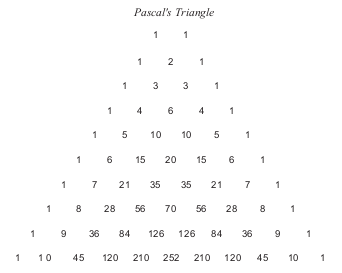
For three to be present you need \left(\frac{1}{7}\right)^3 and for seven to stay away the term is \left(\frac{6}{7}\right)^7.
When writing down these fractions, how many different ways are there of combining them? According to Pascal's Triangle there are 120, so
P(X = 3) = 120\left(\frac{1}{7}\right)^3\left(\frac{6}{7}\right)^7
which is easier to calculate than drawing 1024 branches! The number of ways of choosing 3 from 10 is often written
\binom{10}{3} or ^{10}\text{C}_3
so
P(X = 3) = \binom{10}{3}\left(\frac{1}{7}\right)^3\left(\frac{6}{7}\right)^7
and the probability distribution is
P(X = x) = \binom{10}{x}\left(\frac{1}{7}\right)^x\left(\frac{6}{7}\right)^{10-x}\ \ \ x = 0, 1, ..., 10
Whilst the values needed can easily be read off Pascal's Triangle, there is an even easier way of working out the coefficients given in terms of factorials. Note that n! = n × (n - 1) × ... × 2 × 1 and, for example,
| \binom{10}{3} | = \frac{10!}{7!3!} |
| = \frac{10 × 9 × 8 × (7 × 6 × 5 × 4 × 3 × 2 × 1)}{(7 × 6 × 5 × 4 × 3 × 2 × 1) × (3 × 2 × 1)} | |
| = \frac{10 × 9 × 8}{3 × 2 × 1}\ \ \left(\text{since} \frac{10!}{7!} = 10 × 9 × 8\right) | |
| = 120 |
Check the values of
\binom{10}{1}, \binom{10}{2}, \binom{10}{4} and \binom{10}{5}
by using Pascal's Triangle and the factorial formula.
\binom{10}{1} = \frac{10!}{9! 1!} = 10
\binom{10}{2} = \frac{10!}{8! 2!} = \frac{10 × 9}{2} = 45
\binom{10}{4} = \frac{10!}{6! 4!} = \frac{10 × 9 × 8 × 7}{4 ×3× 2 ×1} = 210
\binom{10}{5} = \frac{10!}{5! 5!} = \frac{10 × 9 × 8 × 7 × 6}{5× 4 ×3× 2 ×1} = 252
It should also be noted that most calculators have the facility to produce the coefficients.
Another notation used for the number of different ways of combining three from ten is
^{10}\text{C}_3, and the majority of calculators have a key labelled with one of ^{n}\text{C}_r or \binom{n}{r}
The instructions for your calculator will show you how to use this function.
In general, when the probability of success is p (instead of ), and the experiment is repeated n independent times with the probability remaining constant, the probability distribution for the number of successes is given by
The notation X ~ B (n, p) is often used.
A practical experiment illustrates its use.
Take five cards numbered from one to five. Seat two people back-to-back and give the cards to one of them. This person selects a card at random and the other participant tries to identify it.
This is done five times and repeated with other pairs of people and you record the result. You can use the Binomial distribution to find the expected number of successes, assuming no skills beyond guessing!
So, if X is 'the number predicted correctly out of five attempts', the probability distribution is
P(X = r) = \binom{5}{1}(0.2)^r(0.8)^{5-r} for x = 0, 1, ... 5
So, for example, the probability of getting one correct is given by
| P(X = 1) | = \binom{5}{1}(0.2)(0.8)^4 |
| = 5(0.2)(0.8)^4 | |
| = 0.4096 |
Hence for 20 people, you would expect
20 × 0.4096 = 8.192 ≈ 8
to get one correct.
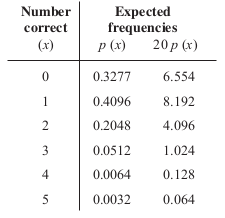
A table of expected frequencies is shown opposite.
Compare your observed frequencies with the theoretical ones.
If X is binomially distributed with 6 trials and a probability of success equal to at each attempt, what is the probability of:
(a) exactly 4 successes (b) at least one success?
This question can be rewritten in the following way.
If X ~ B \left(6,\frac{1}{4}\right), what is: (a) P(X = 4) (b) P(X ≥ 1) ?
(a)
| P(X = 4) | = \binom{6}{4} \binom{1}{4}^4 \binom{3}{4}^2 |
| = 15 × \frac{1}{256} × \frac{9}{16} | |
| = \frac{135}{4096} = 0.033 (to 3 d.p.) |
(b)
| P(X ≥ 1) | = 1 - P(X = 0) |
| = 1 - \left(\frac{3}{4}\right)^6 | |
| = 1 - \frac{729}{4096} | |
| = \frac{3367}{4096} = 0.822 (to 3 d.p.) |
Note
Tables giving cumulative binomial probabilities are given in some calculators or using an online search.
When an unbiased coin is tossed eight times what is the probability of obtaining:
(a) less than 4 heads (b) more than five heads?
H = number of heads ⇒ H ~ B(8, 0.5)
(a)
Using the appropriate Binomial Distribution table you can simply write down the answer,
| P(H < 4) | = P(H ≤ 3) |
| = 0.3633 |
Alternatively,
| P(H ≤ 3) | = P(H = 0) + P(H = 1) + P(H = 2) + P(H = 3) |
| = \left(\frac{1}{2}\right)^8 + \binom{8}{1}\left(\frac{1}{2}\right)\left(\frac{1}{2}\right)^7 + \binom{8}{2}\left(\frac{1}{2}\right)^2\left(\frac{1}{2}\right)^6 + \binom{8}{3}\left(\frac{1}{2}\right)^3\left(\frac{1}{2}\right)^5 | |
| = \left(\frac{1}{2}\right)^8+8\left(\frac{1}{2}\right)^8+28\left(\frac{1}{2}\right)^8+56\left(\frac{1}{2}\right)^8 | |
| = 93\left(\frac{1}{2}\right)^8 | |
| = \frac{93}{256} | |
| = 0.3633 (to 4 d.p.) |
(b)
| P(H > 5) | = 1 - P(H ≤ 5) |
| = 1 - 0.8555 (from tables) | |
| = 0.1445 |
or
| P(H > 5) | = P(H = 6) + P(H = 7) + P(H = 8) |
| = \binom{8}{6}\left(\frac{1}{2}\right)^6\left(\frac{1}{2}\right)^2 + \binom{8}{7}\left(\frac{1}{2}\right)^7\left(\frac{1}{2}\right) + \left(\frac{1}{2}\right)^8 | |
| = 28\left(\frac{1}{2}\right)^8 + 8\left(\frac{1}{2}\right)^8 + \left(\frac{1}{2}\right)^8 | |
| = 37\left(\frac{1}{2}\right)^8 | |
| = \frac{37}{256} | |
| = 0.1445 (to 4 d.p.) |
Exercises

Where decimals are used give answers correct to 3 significant figures.