
Angles and Symmetry
Measuring Angles
A protractor can be used to measure or draw angles.
Note
The angle around a complete circle is 360˚.
The angle around a point on a straight line is 180˚.
Worked Examples
1

Measure the angle CAB in the triangle shown.
Show me
Place a protractor on the triangle as shown.
The angle is measured as 47˚.

Note
When measuring an angle, start from the 0° which is in line with an arm of the angle.
2
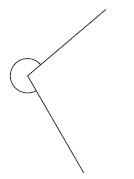
Measure the marked angle.
Show me
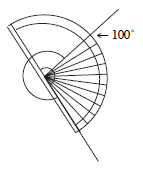
Using a protractor, the smaller angle is measured as 100°.
So
| required angle | = 360° − 100° |
| = 260° |
3
Draw angles of
(a)
120°
Show me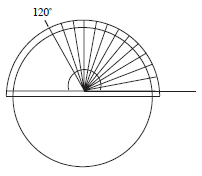
Draw a horizontal line.
Place a protractor on top of the line and draw a mark at 120°.
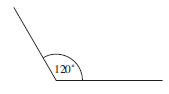
Then remove the protractor and draw the angle.
(b)
330°.
Show meTo draw the angle of 330°, first subtract 330° from 360°:
360° − 330° = 30°
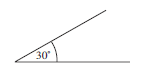
Draw an angle of 30°.
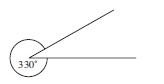
The larger angle will be 330°.
Exercises
