
There are a number of important results concerning angles in different shapes, at a point and on a line. In this section the following results will be used.
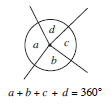
Angles at a Point
The angles at a point will always add up to 360°. It does not matter how many angles are formed at the point – their total will always be 360°.
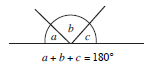
Angles on a Line
Any angles that form a straight line add up to 180°.
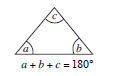
Angles in a Triangle
The angles in any triangle add up to 180°.
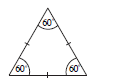
Angles in an Equilateral Triangle
In an equilateral triangle all the angles are 60° and all the sides are the same length.
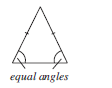
Angles in an Isosceles Triangle
In an isosceles triangle two sides are the same length and two angles are the same size.

Angles in a Quadrilateral
The angles in any quadrilateral add up to 360°.
Worked Examples
Find the sizes of angles a and b in the diagram below.
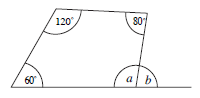
First consider the quadrilateral. All the angles of this shape must add up to 360°, so
| 60° + 120° + 80° + a | = 360° | |
| 260° + a | = 360° | |
| a | = 360° − 260° | |
| = 100° |
Then consider the straight line formed by the angles a and b. These two angles must add up to 180° so,
| a + b | = 180° | |
| but a = 100°, so | ||
| 100°+ b | = 180° | |
| b | = 180° − 100° | |
| = 80° |

Find the angles a, b, c and d in the diagram.
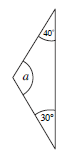
First consider the triangle shown.
The angles of this triangle must add up to 180°, so
40° + 30° + a = 180°

Next consider the angles round the point shown.
The three angles must add up to 360°, so
| 120° + b + a | = 360° | |
| but a = 110°, so | ||
| 120° + 110° + b | = 360° | |
| 230° + b | = 360° | |
| b | = 360° − 230° | |
| = 130° |
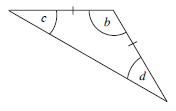
Finally, consider the second triangle.
The angles must add up to 180° , so
c + b + d = 180°
As this is an isosceles triangle the two angles, c and d, must be equal, so using c = d and the fact that b = 130°, gives
| c + 130° + c | = 180° |
| 2c | = 180° − 130° |
| = 50° | |
| c | = 25° |
As c = 25°, d = 25°.
In the figure below, not drawn to scale, ABC is an isosceles triangle with ∠CAB = p° and ∠ABC = (p + 3)°.
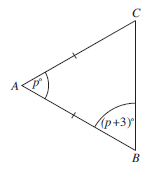
Write an expression in terms of p for the value of the angle at C.
Show meAs ABC is an isosceles triangle,
∠ACB = p + 3°
Determine the size of EACH angle in the triangle.
Show meFor triangle ABC,
| p + (p + 3) + (p + 3) | = 180° | |
| 3p + 6° | = 180° | (take 6 from each side) |
| 3p | = 180° − 6° | |
| 3p | = 174° | (divide both sides by 3) |
| p | = 58° |
Exercises
