
Opposite Angles
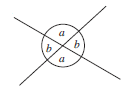
When any two lines intersect, two pairs of equal angles are formed.
The two angles marked a are a pair of opposite equal angles.
The angles marked b are also a pair of opposite equal angles.
Corresponding Angles
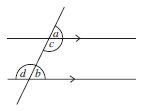
When a line intersects a pair of parallel lines, a = b.
The angles a and b are called corresponding angles.
Alternate Angles
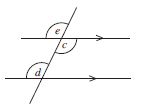
The angles c and d are equal.
Proof
This result follows since c and e are opposite angles, so c = e, and e and d are corresponding angles, so c = d.
Hence c = e = d
The angles c and d are called alternate angles.
Supplementary Angles
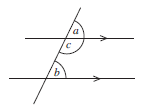
The angles b and c add up to 180° .
Proof
This result follows since a + c = 180° (straight line), and a = b since they are corresponding angles.
Hence b + c = 180°.
These angles are called supplementary angles.
Worked Examples
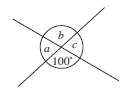
Find the angles marked a, b and c.
There are two pairs of opposite angles here so:
b = 100 and a = c
Also a and b form a straight line so
| a + b | = 180° |
| a +100° | = 180° |
| a | = 80° , so c = 80° |
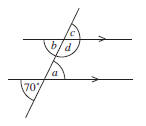
Find the sizes of the angles marked a, b, c and d in the diagram.
First note the two parallel lines marked with arrow heads.
Then find a. The angle a and the angle marked 70° are opposite angles, so a = 70°.
The angles a and b are alternate angles so a = b = 70°.
The angles b and c are opposite angles so b = c = 70°.
The angles a and d are a pair of interior angles, so a + d = 180°, but a = 70°,
so
| 70° + d | = 180° |
| d | = 180° − 70° |
| = 110° |

Find the angles marked a, b, c and d in the diagram.
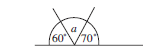
To find the angle a, consider the three angles that form a straight line. So
| 60° + a + 70° | = 180° |
| a | = 180° − 130° |
| = 50° |
The angle marked b is opposite the angle a, so b = a = 50° .
Now c and d can be found using corresponding angles.
The angle c and the 70° angle are corresponding angles, so c = 70°.
The angle d and the 60° angle are corresponding angles, so d = 60°.

In the diagram above, not drawn to scale, AB is parallel to CD and EG is parallel to FH, angle IJL = 50° and angle KIJ = 95°.
Calculate the values of x, y and z, showing clearly the steps in your calculations.
Value of x
Angles BIG and END are supplementary angles, so
| 95° + END | = 180° | |
| END | = 180° − 95° | |
| i.e. | END | = 85° |
But angles END and FMD are corresponding angles, so
85° = x
Value of y
Angles BCD (y) and ABC are alternate angles, so
y = ABC
In triangle BIJ,
| y + 95° + 50° | = 180° | |
| y | = 180° − (95 + 50)° | |
| = 180° − 145° | ||
| i.e. | y | = 35° |
Value of z
Angles AKH (z) and FMD (x) are alternate angles, so
| z | = x° | |
| i.e. | z | = 85° |
Exercises
