
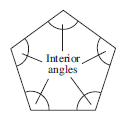
Regular polygons will have both line and rotational symmetry. This symmetry can be used to find the interior angles of a regular polygon.
Worked Examples
Find the interior angle of a regular dodecagon.
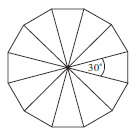
The diagram shows how a regular dodecagon can be split into 12 isosceles triangles.
As there are 360° around the centre of the dodecagon, the centre angle in each triangle is
= 30°
So the other angles of each triangle will together be
180° − 30° = 150°
Therefore each of the other angles will be
= 75°
As two adjacent angles are required to form each interior angle of the dodecagon, each interior angle will be
75° × 2 = 150°
As there are 12 interior angles, the sum of these angles will be 12 × 150° = 1800°.
Find the sum of the interior angles of a regular heptagon.
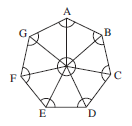
Split the heptagon into 7 isosceles triangles.
Each triangle contains three angles which add up to 180° , so the total of all the marked angles will be
7 × 180° = 1260°.
However the angles at the point where all the triangles meet should not be included, so the sum of the interior angles is given by
1260° − 360° = 900°

Copy the octagon shown in the diagram and draw in any lines of symmetry.
Show meThere is only one line of symmetry as shown in the diagram.
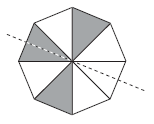
Copy the octagon and shade in extra triangles so that it now has rotational symmetry.
Show meThe original octagon has no rotational symmetry.

By shading the extra triangle shown, it has rotational symmetry of order 4.

By shading all the triangles, it has rotational symmetry of order 8.
Exercises


Investigation
How many squares are there in the given figure?