
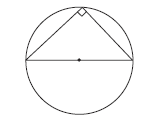
The following results are true in any circle.
When a triangle is drawn in a semi-circle as shown, the angle on the perimeter is always a right angle.
Proof
Join the centre, O, to the point, P, on the perimeter.
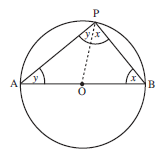
Similarly, triangle AOP is also isosceles and
In triangle ABP, the sum of the angles must be 180° .
| y + x + (x + y) | = 180° | |
| 2x + 2y | = 180° | (collecting like terms) |
| x + y | = 90° | ( ÷ 2) |
But angle APB = x + y, and this is a right angle.
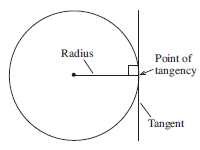
A tangent is a line that touches only one point on the circumference of a circle.
This point is known as the point of tangency.
A tangent is always perpendicular to the radius of the circle.
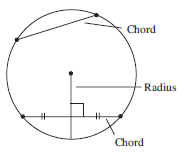
A chord is a line joining any two points on the circle.
The perpendicular bisector is a second line that divides the first line in half and is at right angles to it.
The perpendicular bisector of a chord is always a radius of the circle.
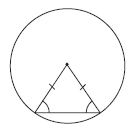
When the ends of a chord are joined to the centre of a circle, an isosceles triangle is formed, so the two angles marked are equal.
Worked Examples
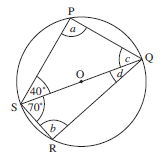
Find the angles marked with letters in the diagram, if O is the centre of the circle.
As both triangles are in semi-circles, angles a and b must each be 90°.
The other angles can be found because the sum of the angles in each triangle is 180° . For the triangle PQS,
| 40° + 90° + c | = 180° |
| c | = 180° − 130° |
| = 50° |
For the triangle QRS,
| 70° + 90° + d | = 180° |
| d | = 180° − 160° |
| = 20° |

Find the angles a, b and c, if AB is a tangent and O is the centre of the circle.
First consider the triangle OAB. As OA is a radius and AB is a tangent, the angle between them is 90°. So
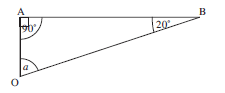
| 90° + 20° + a | = 180° |
| a | = 180° − 110° |
| = 70° |
Then consider the triangle OAC. As OA and OC are both radii of the circle, it is an isosceles triangle with b = c.
So

| 2b + 70° | = 180° |
| 2b | = 110° |
| b | = 55° |
and c = 55°.
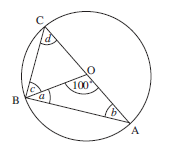
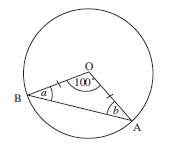
Find the angles marked in the diagram, where O is the centre of the circle.
First consider the triangle OAB.
As the sides OA and OB are both radii, the triangle must be isosceles with a = b.
So
| a + b + 100° | = 180° | |
| but as a = b, | ||
| 2a + 100° | = 180° | |
| 2a | = 80° | |
| a | = 40° |
and b = 40°.
Now consider the triangle ABC.
As the line AC is a diameter of the circle, the angle ABC must be 90°.

So
| a + c | = 90° | |
| or | ||
| 40° + c | = 90° | |
| c | = 50° |
The angles in the triangle ABC must total 180° , so
| 40° + 90°+ d | = 180° | |
| d | = 50° |
Exercises
