
There are a number of important geometric results based on angles in circles. (The first you have met already.)
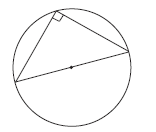
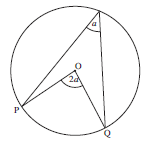
Proof
OP = OC (equal radii), so
angle CPO = angle PCO (= x, say).
Similarly,
angle CQO = angle QCO (= y, say).
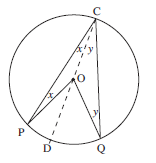
Now, extending the line CO to D, say, note that
| angle POD | = x + x | |
| = 2x |
and, similarly,
| angle QOD | = y + y |
| = 2y |
Hence,
| angle POQ | = 2x + 2y |
| = 2 (x + y) | |
| = 2 × angle PCQ |
as required.
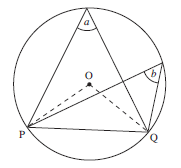
Proof
The angle at the centre is 2a or 2b (according to the first result).
Thus 2a = 2b or a = b, as required.
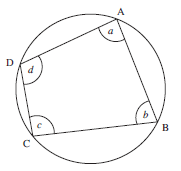
Proof
Construct the diagonals AC and BD, as below.
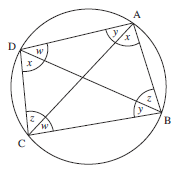
Then label the angles subtended by AB as w; that is
angle ADB = angle ACB (= w)
Similarly for the other chords, the angles being marked x, y and z as shown.
Now, in triangle ABD, the sum of the angles is 180° ,
so
w + z + (x + y) = 180°
You can rearrange this as
(x + w) + (y + z) = 180°
which shows that
angle CDA + angle CBA = 180°
proving one of the results.
The other result follows in a similar way.
Worked Examples
Find the angles marked in the diagrams. In each case O is the centre of the circle.
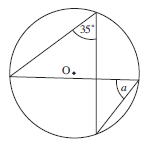 Show me
As both angles are drawn on the same chord, the angles are equal, so
a = 35°
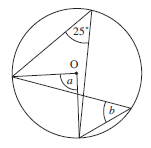 Show me
Angle b and the 25°angle are drawn on the same chord, so
b = 25°
Angle a is drawn at the centre O on the same chord as the 25°angle, so
| a | = 2 × 25° |
| = 50° |
Find the angles marked in the diagrams. O is the centre of the circle.
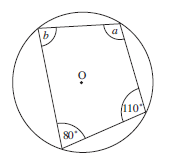 Show me
Opposite angles in a cyclic quadrilateral add up to 180° . So
| a + 80° | = 180° |
| a | = 100° |
| b + 110° | = 180° |
| b | = 70° |
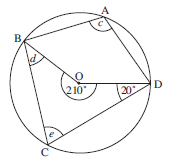 Show me
Consider the angles c and 210° . Since the angle at the centre is double the angle
in a segment drawn on the same arc,
| 2c | = 210° |
| c | = 105° |
| c + e | = 180° |
| 105°+ e | = 180° |
| e | = 180° − 105° |
| = 75° |
| d + e + 210°+ 20° | = 360° |
| d | = 360° − 210° − 20° − e |
| = 130° − c | |
| = 130° − 75° | |
| = 55° |

In the diagram the line AB is a diameter and O is the centre of the circle. Find the angles marked.
Consider triangle OAC. Since OA and OC are radii, triangle OAC is isosceles. So
a = 50°
The angles in a triangle add to 180° , so for triangle OAC,
| a + b + 50° | = 180° |
| b | = 180° − 50° − a |
| = 80° |
Since AB is a diameter of the circle, the angle ACB is a right angle, so
| a + 20° + c | = 90° |
| c | = 90° − 20° − a |
| = 20° |
Angle d and angle OAC are angles in the same segment, so
| d | = angle OAC |
| = 50° |
Angle e is drawn on the same arc as the angle at the centre, AOC, so
| b | = 2e |
| e | = b |
| = 40° |
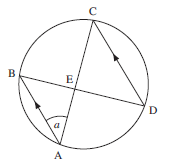
In the diagram the chords AB and CD are parallel. Prove that the triangles ABE and DEC are isosceles.
Angles a and BDC are angles in the same segment, so
angle BDC = a
Since AB and DC are parallel, angles a and ACD are equal alternate angles,
angle ACD = a = angle BDC
Hence in triangle DEC, the base angles at C and D are equal, so the triangle is isosceles.
The angle at B, angle ABD, equals the angle at C, angle ACD, because they are angles in the same segment:
angle ABD = angle ACD = a
Hence triangle ABE is isosceles, since the angles at A and B are equal.
Exercises
