
Some important results are stated below.
If two tangents are drawn from a point T to a circle with centre O, and P and R are the points of contact of the tangents with the circle, then, using symmetry,
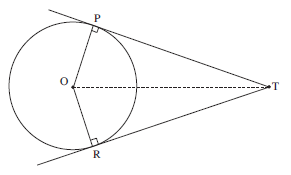
(a)PT = RT
(b)Triangles TPO and TRO are congruent.
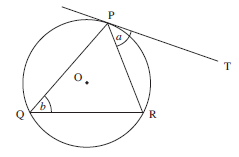
The angle between a tangent and a chord equals an angle at the circumference subtended by the same chord;
e.g. a = b in the diagram.
This is known as the
alternate segment theorem
and needs a proof, as it is not obviously true!
Proof
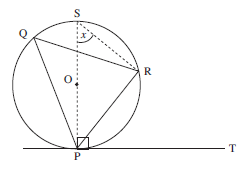
Construct the diameter POS, as shown.
We know that
angle SRP = 90°
since PS is a diameter.
Now
angle PSR = angle PQR = x°, say,
so
| angle SPR | = 180° − 90° − x |
| = 90° − x° |
But
| angle RPT | = 90° − (angle SPR) |
| = 90° − (90° − x°) | |
| = x° | |
| = angle PQR |
and the result is proved.
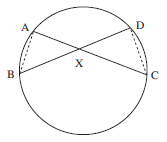
For any two intersecting chords, as shown,
The proof is based on similar triangles.
Proof
In triangles AXB and DXC,
angle BAC = angle BDC (equal angles subtended by chord BC)
and
angle ABD = angle ACD (equal angles subtended by chord AD)
As AXB and DXC are similar,
= ⇒ AX.CX = BX.DX
as required.
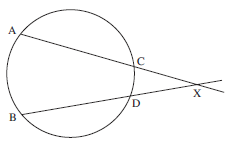
This result will still be true even when the chords intersect outside the circle, as illustrated opposite.
How can this be proved?
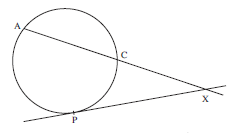
When the chord BD becomes a tangent, and B and D coincide at the point P, then
AX × CX = PX × PX
or
Worked Examples
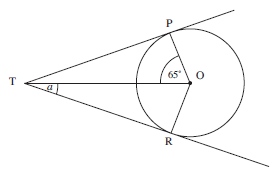
Find the angle a in the diagram.
The triangles TOR and TOP are congruent, so
angle TOR = 65°
Since TR is a tangent to the circle and OR is a radius,
angle TRO = 90°.
Hence
| a | = 180° − 90° − 65° |
| = 25° |
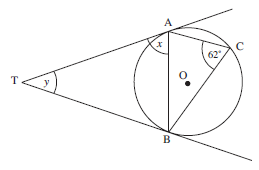
Find the angles x and y in the diagram.
The alternate angle segment theorem gives
x = 62°
The tangents TA and TB are equal in length, so the triangle TAB is isosceles.
So
angle ABT = x = 62°
Hence
| y + 62° + 62° | = 180° | (the angles in triangle TAB add up to 180° ) |
| y | = 56° |
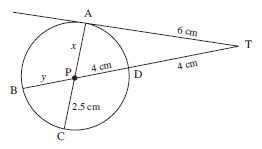
Find the unknown lengths in the diagram.
Since AT is a tangent,
| AT2 | = BT . DT |
| 36 | = BT × 4 |
| BT | = 9 |
Hence
| y + 8 | = BT = 9 |
| y | = 1 cm |
AC and BD are intersecting chords, so
| AP . PC | = BP . PD |
| 2.5x | = 1 × 4 |
| x | = |
| = 1.6 cm |
Exercises
