
Solutions to pairs of simultaneous equations can be found by plotting lines and finding the coordinates of the point where they intersect. They can be solved analytically but this introduces a more general method which we extend in later units.
Worked Examples
Solve the pair of simultaneous equations
x + y = 8 and 2x + 3y = 21
First it can be helpful to write the two equations in the form y = ... .
For the first equation,
| x + y | = 8 | |
| y | = 8 − x | (subtracting x) |
For the second equation,
| 2x + 3y | = 21 | |
| 3y | = 21 − 2x | (subtracting 2x) |
| y | = 7 − x | (dividing by 3) |
Now two pairs of coordinates can be found for each line.
| For | y = 8 − x | |
| If | x = 0 , y = 8 | so (0, 8) lies on the line |
| If | x = 8 , y = 8 − 8 = 0 | so (8, 0) lies on the line. |
| For | y = 7 − x | |
| If | x = 0 , y = 7 − 0 = 7 | so (0, 7) lies on the line. |
| If | x = 6 , y = 7 − × 6 = 7 − 4 = 3 | so (6, 3) lies on the line. |
These points are then used to plot the lines shown below.
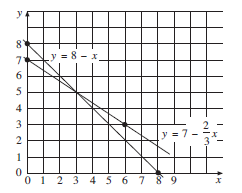
The two lines intersect at the point (3, 5), so the solution is
x = 3 and y = 5
Note
We can easily solve these equations analytically by writing
x + y = 8 ⇒⎬
⎭ subtract 2 from 1 to give = y = 5
Substituting back in either equation gives x; for example,
x = 8 − y = 8 − 5 = 3
Hence solution at (3, 5).
Exercises
