
Straight Lines
Gradients of Perpendicular Lines

In this section we explore the relationship between the gradients of perpendicular lines and line segments.

Worked Examples

1
(a)

Plot the points A (1, 2) and B (4, 11), join them to form the line AB and then calculate the gradient of AB.

Show me
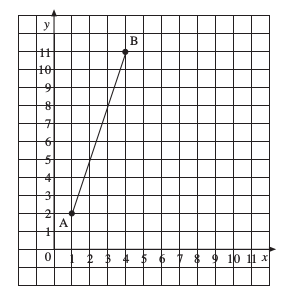
The points are shown in the diagram.

Gradient of AB = = = 3

(b)

On the same set of axes, plot the points P (5, 4) and Q (8, 3), join them to form the line PQ and then calculate the gradient of PQ.

Show me

The points P and Q can now be added to the diagram as shown below.
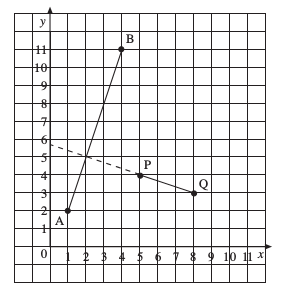
Gradient of PQ = =

(c)

Measure the angle between the lines AB and PQ. What do you notice about the two gradients?

Show me

The line PQ has been extended on the diagram, so that the angle between the two lines can be measured.

The angle is 90°, a right angle.

In this case,

the gradient of AB = 3; the gradient of PQ =

and the gradients multiply to give 3 × ⎛
⎝
⎞
⎠
= −1.

Note

The product of the gradients of two perpendicular lines will always be –1, unless one of the lines is horizontal and the other is vertical.

In the example above,

gradient of AB = 3

gradient of PQ =

3 × ⎛
⎝
⎞
⎠
= −1

Note

Gradient of PQ = .

If the gradient of a line is m, and m ≠ 0 , then the gradient of a perpendicular line will be .
2

Show that the line segment joining the points A (3, 2) and B (5, 7) is perpendicular to the line segment joining the points P (2, 5) and Q (7, 3).

Show me

Gradient of AB = =

Gradient of PQ = =

Gradient of AB × Gradient of PQ = × = = −1.

So the line segments AB and PQ are perpendicular.

Exercises

In each case, decide whether the lines AB and PQ are parallel, perpendicular or neither.

(a)
A (4, 3)   B (8, 4)   P (7, 1)   Q (6, 5)
(b)
A (–2, 0)   B (1, 9)   P (2, 5)   Q (6, 17)
(c)
A (8, –5)   B (11, –3)   P (1, 1)   Q (–3, 7)
(d)
A (3, 1)   B (7, 3)   P (–3, 2)   Q (1, 0)

The points P (–3, 1), Q (1, 2), R (0, –1) and S (–4, –2) are the vertices of a quadrilateral.

(a)
Calculate the gradient of each side of the quadrilateral.

PQ:

QR:

RS:

SP:

(b)
Is the quadrilateral a parallelogram?
(c)
Is the quadrilateral a rectangle?

A triangle has vertices A (3, 1), B (7, 5) and C (1, 3). Is the triangle a right-angled triangle?

The points A (3, 2), B (6, 0), C (5, 4) and D (2, 6) are the vertices of a quadrilateral.

(a)

Is this a rectangle?

(b)

Is this a parallelogram?

The lines AB and PQ are perpendicular. The coordinates of the points are

A (3, 2)   B (7, 4)   P (3, 7)   and   Q (6, q)

Determine the value of q.

q =