Straight Lines
The Equation of a Straight Line

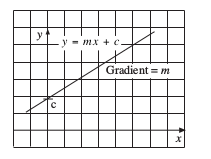
The equation of a straight line is usually written in the form

y = mx + c

where m is the gradient and c is the y intercept.

Worked Examples
1

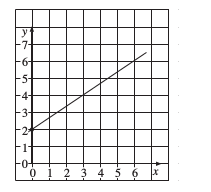
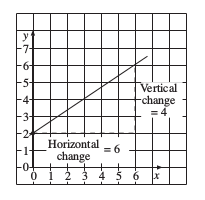
Find the equation of the line shown in the diagram.
Show me

The first step is to find the gradient of the line.

Drawing the triangle shown under the line gives

gradient =
=
=

So the value of m is . The line intersects the y-axis at 2, so the value of c is 2. The equation of a straight line is

y = mx + c

In this case

y = x + 2

2

Find the equation of the line that passes through the points (1, 5) and (3, 1).

Show me

Plotting these points gives the straight line shown. Using the triangle drawn underneath the line allows the gradient to be found.

gradient =
=
= −2

The y intercept is 7.

So m = −2 and c = 7 and the equation of the line is

y = −2x + 7   or   y = 7 − 2x

3
(a)

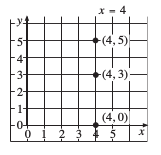
Draw the line x = 4.

Show me

For the line x = 4 the x-coordinate of every point will always be 4. So the points

(4, 0)   (4, 3)   (4, 5)

all lie on the line x = 4.

(b)

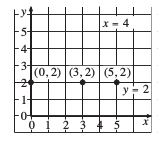
Draw the line y = 2.

Show me

For the line y = 2 the y-coordinate of every point will always be 2. So the points

(0, 2)   (3, 2)   and   (5, 2)

all lie on the line y = 2.

(c)

Write down the coordinates of the point of intersection of these lines.

Show me

The graph in (b) shows that the lines intersect at the point with coordinates (4, 2).

4

The point with coordinates (4, 9) lies on the line with equation y = 2x + 1. Determine the equation of the perpendicular line that also passes through this point.

Show me

The line y = 2x + 1 has gradient 2.

The perpendicular line will have gradient − and so its equation will be of the form

y = −x + c

As the line passes through (4, 9), we can use x = 4 and y = 9 to determine the value of c.

9 = − × 4 + c
9 = −2 + c
c = 11

The equation of the perpendicular line is therefore

y = −x + 11

The graph shows both lines.

5

In the diagram above, not drawn to scale, AB is the straight line joining A (−1, 9) and B (3, 1).

(a)

Calculate the gradient of the line, AB.

Show me

Gradient of AB = = = −2

(b)

Determine the equation of the line, AB.

Show me

Equation of line AB

y = mx + c ⇒ y = −2x + c

As it passes through (3, 1),

1 = −2 × 3 + c ⇒ c = 7
i.e. y = −2x + 7
(c)

Write the coordinates of G, the point of intersection of AB and the y-axis.

Show me

x = 0, so y = −2 × 0 + 7 = 7.   G is point (0, 7).

(d)

Write the equation of the line through O, the origin, that is perpendicular to AB.

Show me

Gradient = = =

So y = x   (as it passes through the origin)

(e)

Write the equation of the line through O that is parallel to AB.

Show me

The line parallel to AB has gradient −2, so the line through O has equation

y = −2x

Exercises

Find the equation of the straight line with:

(a)

gradient = 2 and y-intercept = 4,

y =
(b)

gradient = 3 and y-intercept = –5,

y =
(c)

gradient = and y-intercept = 2,

y =
(d)

gradient = −2 and y-intercept = 1,

y =
(e)

gradient = and y-intercept = –3.

y =

Write down the gradient and y-intercept of each line.

(a)

y = 2x + 3

gradient =

y-intercept =

(b)

y = 4x − 2

gradient =

y-intercept =

(c)

y = x + 1

gradient =

y-intercept =

(d)

y = x − 4

gradient =

y-intercept =

(e)

y = 4(x + 2)

gradient =

y-intercept =

(f)

y = 3(x − 7)

gradient =

y-intercept =

(g)

y =

gradient =

y-intercept =

(h)

y =

gradient =

y-intercept =

The diagram shows the straight line that passes through the points (2, 1) and (5, 4).

(a)

Find the gradient of the line.

(b)

Write down the y-intercept.

(c)

Write down the equation of the straight line.

Write down the gradient of each line and the coordinates of the y-intercept.

(a)

y = 2x − 8

gradient =

y-intercept = (, )

(b)

y = − 3x + 2

gradient =

y-intercept = (, )

(c)

y = 4x − 3

gradient =

y-intercept = (, )

(d)

y = x + 2

gradient =

y-intercept = (, )

(e)

y = 8 − 2x

gradient =

y-intercept = (, )

(f)

y = 4 − 3x

gradient =

y-intercept = (, )

(g)

x + y = 8

gradient =

y-intercept = (, )

(h)

y = 3(5 − x)

gradient =

y-intercept = (, )

(a)

The line y = x + c passes through the point (4, 7). Find the value of c.

c =
(b)

The point (5, –2) lies on the line y = 2x + c. Find the value of c.

c =
(c)

The line y = mx + 2 passes through the point (3, 17). Find the value of m.

m =

Television repair charges depend on the length of time taken for the repair, as shown on the graph.

The charge is made up of a fixed amount plus an extra amount which depends on time.

(a)

Calculate the gradient of the line.

(b)

Write down the equation of the line.

c =
(c)

What is the charge for a repair which takes 45 minutes?

£
(d)

Mr Banks' repair will cost £84 or less. Calculate the maximum amount of time which can be spent on the repair.

minutes

The cost of hiring a taxi consists of a basic charge plus a charge per km travelled.

The graph below shows the total cost in pounds (y) for the number of km travelled (x).

(a)

What is the cost of hiring a taxi to travel a distance of

(i)
250 km £
(ii)
155 km? £
(b)

What distance in km was travelled when the cost was £40?

km
(c)

What is the amount of the basic charge?

£
(d)

Calculate the gradient of the line.

(e)

Write down the equation of the line in the form y = mx + c.

(f)

Calculate the cost of hiring a taxi to travel a distance of 330 km.

£

A line has equation y = 4x − 1. Another line is parallel to this and passes through the point with coordinates (5, 2).

Determine the equation of this line.

y =