
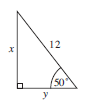
When one angle and the length of one side are known, it is possible to find the lengths of other sides in the same triangle, by using the sine, cosine or tangent formula.
For example,
sin50° = ⇒ x = 12 sin50°
cos50° = ⇒ y = 12 cos50°
Worked Examples
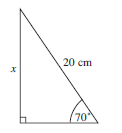
Find the length of the side marked x in the triangle shown.
In this triangle,
hypotenuse = 20 cm
opposite = x cm
Choose sine because it involves hypotenuse and opposite.
Using sinθ =
gives sin70° =
To obtain x, multiply both sides of this equation by 20, which gives
| 20 sin70° | = x | ||
| or | |||
| x | = 20 sin70° | ||
| = 18.8 cm | (to 1 decimal place) |
This value is obtained using a calculator.
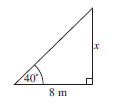
Find the length of the side marked x in the triangle.
In this triangle,
opposite = x
adjacent = 8 metres
Use tangent because it involves the opposite and adjacent.
Using tanθ =
gives tan40° =
Multiplying both sides by 8 gives
| 8 tan40° | = x | ||
| or | |||
| x | = 8 tan40° | ||
| = 6.7 metres | (to 1 decimal place) |
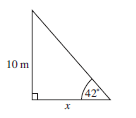
Find the length marked x in the triangle.
In this triangle, tan42° = =
Multiplying by x gives
x tan42° = 10
and dividing by tan42° gives
| x | = | |
| = | ||
| = 11.1 metres | (to 1 decimal place) |
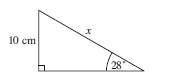
Find the length of the hypotenuse, marked x, in the triangle.
In this triangle,
hypotenuse = x
opposite = 10 cm
Use sine because it involves hypotenuse and opposite.
Using sinθ =
gives sin28° =
where x is the length of the hypotenuse.
Multiplying both sides by x gives
x sin28° = 10,
then dividing both sides by sin 28° gives
| x | = | |
| = 21.3 cm | (to 1 decimal place) |
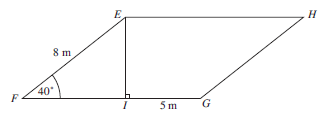
The diagram above, not drawn to scale, represents one face of the roof of a house in the shape of a parallelogram EFGH. Angle EFI = 40° and EF = 8 m. EI represents a rafter placed perpendicular to FG such that IG = 5 m.
Calculate, giving your answers to 3 significant figures,
the length of FI
Show meFI = 8 cos40 ≈ 6.13 m
the length of EI
Show meEI = 8 sin40 ≈ 5.14 m
the area of EFGH.
Show me| Area of EFGH | = FG × EI |
| = (5 + 6.13) × 5.14 | |
| = 11.13 × 5.14 | |
| ≈ 57.2 m2 |
Exercises
