
Trigonometric Ratios
Finding Angles in Right Angled Triangles

If the lengths of any two sides of a right angled triangle are known, then sine, cosine and tangent can be used to find the angles of the triangle.

Worked Examples
1

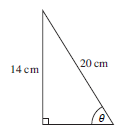
Find the angle marked θ in the triangle shown.

Show me

In this triangle,

hypotenuse = 20 cm

opposite = 14 cm

Usingsinθ =

givessinθ =
= 0.7

So θ = sin−1(0.7)

and using the SHIFT and SIN buttons on a calculator gives θ = 44.4° (to 1 d.p.)
2

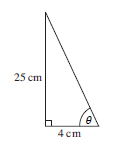
Find the angle marked θ in the triangle shown.

Show me

In this triangle,

opposite = 25 cm

adjacent = 4 cm

Usingtanθ =

givestanθ =
= 6.25

Soθ = tan−1(6.25)

and using the SHIFT and TAN buttons on a calculator gives θ = 80.9° (to 1 d.p.)

3

The diagram above shows triangle PQR, not drawn to scale.

PQ = 20 cm, ∠QPR = 30°, QS is perpendicular to PR, SR = 9 cm, and ∠SQR = x° .

Calculate

(a)

the length of QS

Show me
QS = 20 sin30°
= 10 cm
(b)

the size of angle x to the nearest degree.

Show me
tanx =
= 0.9
x = tan−1(0.9)

and using the SHIFT and TAN buttons on a calculator gives

x ≈ 41.987° ≈ 42° to the nearest degree.

Exercises

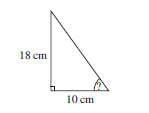
Find the angle θ of:

Give your answers rounded to 1 decimal place.

(a)
θ = °
(b)
θ = °
(c)
θ = °
(d)
θ = °
(e)
θ = °
(f)
θ = °
(g)
θ = °
(h)
θ = °
(i)
θ = °
(j)
θ = °
(k)
θ = °
(l)
θ = °

A ladder leans against a wall. The length of the ladder is 4 metres and the base is 2 metres from the wall. Find the angle between the ladder and the ground.

°

A flag pole is fixed to a wall and supported by a rope, as shown.

Find the angle between

(a)

the rope and the wall

° (to 1 d.p.)
(b)

the pole and the wall.

° (to 1 d.p.)

The mast on a yacht is supported by a number of wire ropes. One, which has a length of 15 metres, goes from the top of the mast at a height of 10 metres, to the front of the boat.

(a)

Find the angle between the wire rope and the mast.

° (to 1 d.p.)
(b)

Find the distance between the base of the mast and the front of the boat.

m (to 2 d.p.)

A soldier runs 500 metres east and then 600 metres north. If he had run directly from his starting point to his final position, what bearing should he have run on?

°

A ship is 50 km south and 70 km west of the port that it is heading for. What bearing should it sail on to reach the port?

°

In the diagram below, not drawn to scale, EFGH is a rectangle. The point D on HG is such that ED = DG = 12 cm and GDF = 43°.

Calculate correct to one decimal place

(a)

the length of GF

cm (to 1 d.p.)
(b)

the length of HD

cm (to 1 d.p.)
(c)

the size of the angle HDE.

° (to 1 d.p.)

The diagram shows a roofing frame ABCD. AB = 7 m, BC = 5 m, angle ABD = angle DBC = 90°

(a)

Calculate the length of AD.

m (to 2 d.p.)
(b)

Calculate the size of angle DCB.

° (to 2 d.p.)