
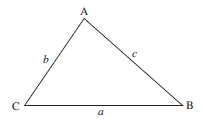
In the triangle ABC, the side opposite angle A has length a, the side opposite angle B has length b and the side opposite angle C has length c.
The sine rule states
Proof of Sine Rule
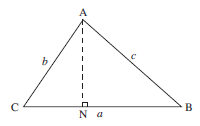
If you construct the perpendicular from vertex A to meet side CB at N, then
| AN | = csinB | (from Δ ABN) |
| = bsinC | (from Δ ACN) |
Hence
csinB = bsinC ⇒ =
similarly for .
The cosine rule states
a2 = b2 + c2 − 2bccosA
b2 = c2 + a2 − 2cacosB
c2 = a2 + b2 − 2abcosC
Proof of Cosine Rule
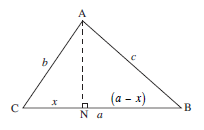
If CN = x, then NB = a − x and
| c2 | = AN2 + (a − x)2 when x = CN |
| = (bsinC)2 + (a − bcosC)2, since x = bcosC | |
| = b2sin2C + b2cos2C − 2abcosC + a2 | |
| = b2(sin2C + cos2C) + a2 − 2abcosC |
i.e. c2 = b2 + a2 − 2abcosC, since sin2C + cos2C = 1
Worked Examples
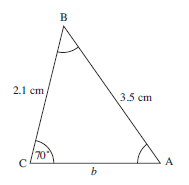
Find the unknown angles and side length of the triangle shown.
Using the sine rule,
= =
From the first equality,
| sinA | = = 0.5638 |
| A | = 34.32° |
Since angles in a triangle add up to 180° ,
B = 180° − 70° − A = 75.68°
From the sine rule,
| = | |
| b | = |
| = | |
| = 3.61 cm |
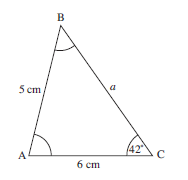
Find two solutions for the unknown angles and side of the triangle shown.
Using the sine rule,
= =
From the second equality,
sinB = = 0.8030
A graph of sinx shows that between 0° and 180° there are two solutions for B.
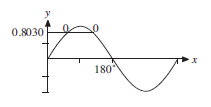
These solutions are B = 53.41° and, by symmetry,
B = 180 − 53.41 = 126.59°
Solving for angle A we have
A = 180° − 42° − B
when B = 53.41°, A = 84.59°
when B = 126.59°, A = 11.41°
From the sine rule,
a =
For A = 84.59°, B = 53.41°, a = 7.44 cm
For A = 11.41°, B = 126.59°, a = 1.48 cm
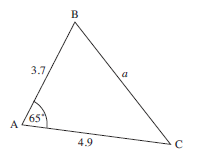
Find the unknown side and angles of the triangle shown.
To find a, use the cosine rule:
a2 = 4.92 + 3.72 − 2 × 4.9 × 3.7 × cos65°
a2 = 22.3759
a = 4.73 (to 2 d.p.)
To find the angles, use the sine rule:
= =
| sinB | = = = 0.9389 |
| B | = 69.86° |
| sinC | = = = 0.7090 |
| C | = 45.15° (alternatively, use A + B + C = 180° to find C) |
Checking, A + B + C = 65°+ 69.86°+ 45.15°= 180.01°. The three angles should add to 180°; the extra 0.01° is due to rounding errors.
The diagram below, not drawn to scale, shows the journey of a ship which sailed from Port A to Port B and then to Port C. Port B is located 32 km due West of Port A and Port C is 45 km from Port B on a bearing of 040° .
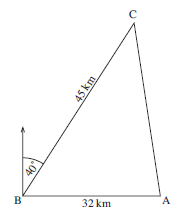
Calculate, giving your answers correct to 3 significant figures
the distance AC
Show meUsing the COSINE rule,
AC2 = BC2 + BA2 − 2 × BC × BA × cosCBA
As angle CBA = 90° − 40°, then
| AC2 | = 322 + 452 − 2 × 32 × 45 × cos50° |
| ≈ 1197.77 |
| AC | ≈ 34.6088 |
| = 34.6 to 3 significant figures |
the bearing of Port C from Port A.
Show me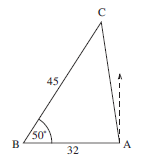
The bearing of C from A is
270° + angle BAC
Using the SINE rule, =
| sinBAC | = |
| ≈ 0.9960 |
| So angle BAC | ≈ 84.903° |
| = 84.9° to 3 significant figures |
Hence the bearing of Port A from Port B is
| 270° + 84.9° | = 354.9° |
| = 355° to 3 significant figures |
Some important values of sinθ, cosθ and tanθ are shown in this table.
| θ | sinθ | cosθ | tanθ |
| 0° | 0 | 1 | 0 |
| 30° | |||
| 45° | 1 | ||
| 60° | |||
| 90° | 1 | 0 | infinite |
The graphs of sinθ and cosθ for any angle are shown in the following diagrams.
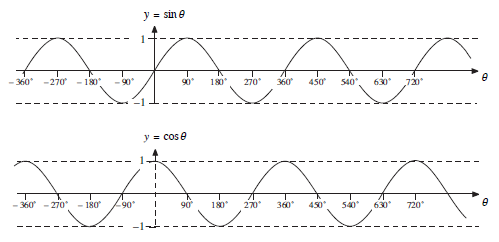
The graphs are examples of periodic functions. Each basic pattern repeats itself every 360°. We say that the period is 360°.
An oil tanker leaves Town X, and travels on a bearing of 050° to Town Z, 50 km away. The tanker then travels to Town Y, 70 km away, on a bearing of 120° .
Draw a carefully labelled diagram of the tanker's journey, clearly showing the North line.
Show me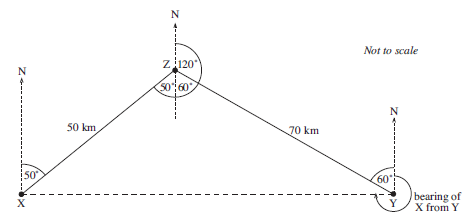
Calculate the distance of Y from X, giving your answer to 3 significant figures.
Show me In triangle XZY, angle XZY = 50° + 60°= 110° so, using the cosine rule,| XY2 | = 502 + 702 − 2 × 50 × 70 × cos110° |
| = 2500 + 4900 − 7000cos110° | |
| ≈ 7400 − 7000 × (−0.3420) | |
| ≈ 9794.14 |
| XY | ≈ 98.965 |
| = 99.0 to 3 significant figures. |
On your diagram, mark the angle that shows the bearing of X from Y.
Show meAs marked on diagram.
Calculate the bearing of X from Y, giving your answer to the nearest degree.
Show meWe need to find the angle ZYX to determine the bearing of X from Y.
In triangle ZYX, using the sine rule,
≈
sinZYX ≈ 0.4748
angle ZYX ≈ 28.34° = 28° to the nearest degree
Hence the bearing of X from Y
= 360° − (60° + 28°)
= 272°
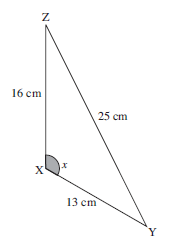
Find the shaded angle in the triangle shown.
Using the cosine rule,
252 = 162 + 132 − 2 × 16 × 13cosx
Rearranging,
| 2 × 16 × 13cosx | = 162 + 132 − 252 |
| 416cosx | = −200 |
| cosx | = |
| x | ≈ cos−1⎛ ⎝⎞ ⎠° |
| = 118.7° to 1 decimal place | |
| using the and buttons on a calculator. |
Note
As cosx is negative, the angle will be obtuse (90° ≤ x ≤ 180°).Exercises
