
An important application of trigonometry is that of finding the area of a triangle with side lengths a and b and included angle θ.
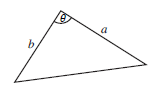
The area (A) is given by absinθ°.
Proof
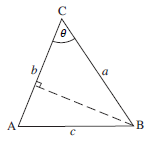
If you construct the perpendicular from the vertex B to AC, then its length, p, is given by
p = asinθ
Thus the area of ABC is given by
| area | = × base × height |
| = × b × p | |
| = × b × (asinθ) | |
| = absinθ |
as required.
Worked Examples

The diagram shows a circle of radius 64 cm.
The length of the chord AB is 100 cm.
Find the angle θ, to 2 d.p.
Show me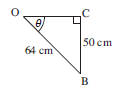
If AB = 100 cm then, by symmetry, BC = 50 cm.
| sinθ | = |
| θ | = 51.38° |
Find the area of triangle OAB.
Show meThe area of the triangle OAB is × 642 × sin2θ = 1997 cm2
Given that sinθ = , 0° ≤ θ ≤ 90°
Express in fractional or surd form the value of cosθ.
Show mesin2θ + cos2θ = 1
so
| cos2θ | = 1 − ⎛ ⎝⎞ ⎠2 |
| = 1 − | |
| = |
Hence
cosθ =
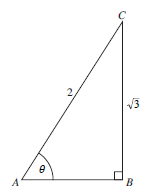
[ An alternative approach is to consider the right angled triangle, as shown.
If the lengths
BC = , AC = 2
then clearly sinθ = . We can find the length AB:
| AB2 | = AC2 − CB2 (Pythagoras) |
| = 4 − 3 = 1 |
So AB = 1 and cosθ = = ]
Show that the area of triangle CDE is 150 square units, where CD = 30 units and DE = 20 units.
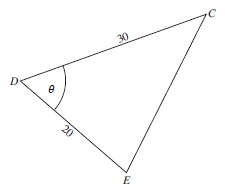
In the given triangle,
| Area | = × CD × DEsinθ |
| = × 30 × 20 × | |
| = 150 |
Calculate the length of the side EC.
Show meWe can find the length EC using the cosine rule, namely
| EC2 | = DE2 + DC2 − 2 × DE × DC × cosθ |
| = 202 + 302 − 2 × 20 × 30 × | |
| = 400 + 900 − 600 | |
| = 700 | |
| EC | ≈ 26.5 |
Exercises
