
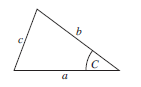
You have already met the formula for the area of a triangle when the lengths of two sides and the included angle are known,
We will use this result to find the formula for the area of a triangle when the lengths of all three sides are known.
The formula is credited to Heron (or Hero) of Alexandria, and a proof can be found in his book, Metrica, written in about AD 60.
The formula, known as Heron's formula, is given by
where
s =
The proof is given below. Although straightforward, it does involve detailed algebraic manipulation.
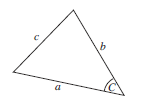
Proof
You start with the formula
By definition, in a right angled triangle,
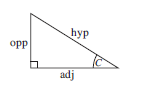
| sinC | = |
| ⇒ (sinC)2 | = |
| = (using Pythagoras' theorem) | |
| = 1 − | |
| = 1 − (cosC)2 |
Thus
| A | = ab |
| = ab |
But, from the cosine rule (Unit 34),
| c2 | = a2 + b2 − 2abcosC |
| i.e. cosC | = |
Substituting into the formula for A,
| A | = ab
√
⎛ ⎝1 − ⎛ ⎝ ⎞ ⎠⎞ ⎠⎛ ⎝1 + ⎛ ⎝ ⎞ ⎠⎞ ⎠ |
|
| = ab | ||
| = | ||
| = | ||
| = | ||
| But | s | = (a + b + c) |
| and | ||
| s − a | = (a + b + c) − a = (b + c − a) | |
| s − b | = (a + c − b) | |
| s − c | = (a + b − c) | |
| giving | ||
| A | = | |
| = |
as required.
Worked Examples
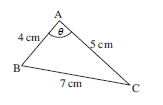
For the triangle shown, find
the area of the triangle,
Show meUsing Heron's formula
| A | = | |
| where | s | = (4 + 5 + 7) = 8 cm |
| A | = = = 9.80 cm2 |
angle θ.
Show meUsing the formula A = absinθ°
| sinθ | = = = 0.98 |
| θ | = 78.5° |
Exercises
