
You will be familiar with using degrees to measure angles, but this is not the only way to do it. In fact, in some areas of mathematics it is not even the most convenient way.
Radians are an alternative unit of measure for angles, often used in trigonometry.
Radians relate the arc length of a sector to its angle.
Worked Examples
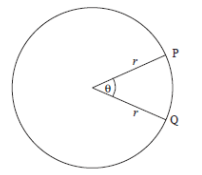
The figure opposite shows a circle of radius r and arc PQ which is subtended by an angle of θ degrees.
What is the length of the complete circumference?
Show meCircumference of circle = 2πr
What is the arc length PQ in terms of θ and r?
Show meArc length PQ = × 2πr
If PQ = r, what is the value of θ ?
Show meIfPQ = r,
thenr = × 2πr
thenθ =
thenθ = degrees
The Worked Example above gives the clue as to how radians are defined. One radian corresponds to the angle which gives the same arc length as the radius. So if θ is the angle POQ in degrees,
| Then, when PQ = r, | θ | = degrees (see above) |
| So | 1 radian | = degrees |
This is not a very convenient definition, so it is usual to note that:
π radians ≡ 180 degrees
Note also that:
Convert the following angles in degrees to radians.
(a) 90° (b) 360° (c) 720° (d) 60°
Since 180° = π radians,
(a) 90° = radians
(b) 360° = 2π radians
(c) 720° = 4π radians
(d) 60° = radians
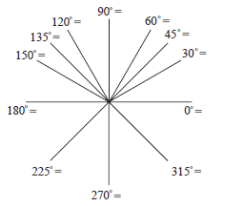
Copy the diagram opposite, putting in the equivalent radian measure for each angle given in degrees.
Working anticlockwise from 0°, the conversions are as follows:
(i) 0° = 0 × radians = 0 radians
(ii) 30° = 30 × radians = radians
(iii) 45° = 45 × radians = radians
(iv) 60° = 60 × radians = radians
(v) 90° = 90 × radians = radians
(vi) 120° = 120 × radians = radians
(vii) 135° = 135 × radians = radians
(viii) 150° = 150 × radians = radians
(ix) 180° = 180 × radians = π radians
(x) 225° = 225 × radians = radians
(xi) 270° = 270 × radians = radians
(xii) 315° = 315 × radians = radians
As you have seen, there is a one to one correspondence between degrees and radians so that
θ° = θ × radians or θ radians ≡ (θ × )°
Use the formulae above to convert:
to radians: (i) 75° (ii) 20° (iii) 105°
Show me(i) 75° = 75 × radians = radians
(ii) 20° = 20 × radians = radians
(iii) 105° = 105 × radians = radians
to degrees: (i) radians (ii) radians
Show me(i) radians = ( × )° = 120°
(ii) radians = ( × )° = 15°
Exercises
