
You are probably familiar with the uses of sine, cosine and tangents in right angled triangles, but the following activities will further revise the concepts.
Worked Examples
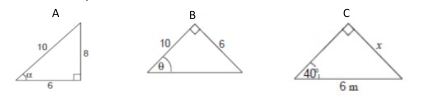
Write down the sine, cosine and tangent of the angle marked in triangle A.
Show mesin θ = cos θ = tan θ =
Find the angle marked, to 1 d.p, in triangle B.
Show metan θ = θ = tan-1 θ = 31.0° to 1 d.p.
Find the length marked x to 2 d.p. in triangle C.
Show mesin 40 = 6 sin 40 = x x = 3.86 to 2 d.p.
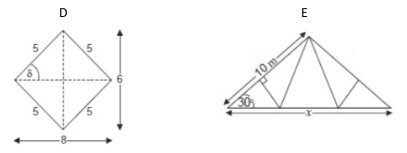
Find the angle δ in the rhombus labelled D.
Show me sin δ = δ = sin-1 δ = 36.9° to 1 d.p.The sketch labelled E shows the frame of a roof. Find the width x.
Show me cos 30 = \frac{\frac{x}{2}}{10} 10 cos 30 = \frac{x}{2} 10\frac{\sqrt{3}}{2} = \frac{x}{2} x = 10\sqrt{3}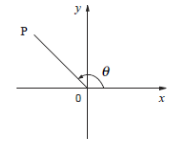
You have seen how sine, cosine and tangent are defined for angles between 0° and 90° but this can be extended to other angles.
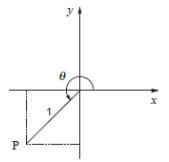
Angles of more than 90° can be defined as the angle θ made between a rotating 'arm' OP and the positive x axis, as shown opposite. It is possible to define angles of more than 360° in this way, or even negative angles, as shown in the next diagram.
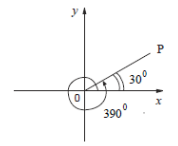
If the length of OP is 1 unit, then the sine, cosine and tangent of any angle is defined in terms of the x and y co-ordinates of the point P as follows;
sin θ = y cos θ = x tan θ =
Note
sin θ, cos θ and tan θ may be negative for certain values of θ. For instance in the figure opposite, y and x are negative, whilst tan θ is positive.
Scientific calculators give sine, cosine and tangent of any angle.
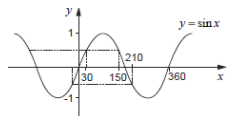
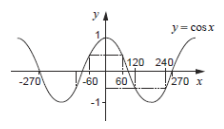
The functions y = sin x and y = cos x can be plotted on a graphic calculator or computer, or indeed by hand, for every 100 interval between 0° and 360°. A smooth curve is drawn through the points.
The maximum and minimum values of the function y are 1 and −1.
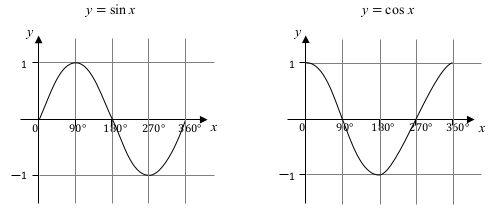
Both functions, sin x and cos x, lie between ±1. The amplitude is the height from the x-axis (or centre-line) to the peak (or trough). The amplitude for both sine and cosine functions is 1.
Whilst we have only plotted the functions for 0 ≤ x ≤ 360°, it is easy to see how it can be extended.
For the range 360° ≤ x ≤ 720°, the pattern will repeat itself, and similarly for negative values. A period is the length of one cycle, before the pattern repeats. The period for both sine and cosine functions is 360°. The graphs are illustrated below.
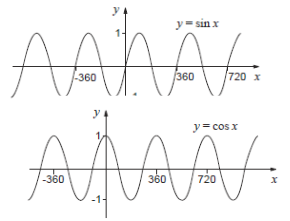
You can see from these graphs that y = sin x is an odd function (y(−x) = −y(x)), whilst y = cos x is an even function (y(−x) = y(x)).
You can always use your calculator to find values of sine and cosine of an angle although sometimes it is easier to use the properties of the functions.
Show that sin 30° = and find the following without using a calculator:
(a) sin 150° (b) sin (−30°) (c) sin 210° (d) sin 390°
(e) cos 60° (f) cos 120° (g) cos (−60°) (h) cos 240°
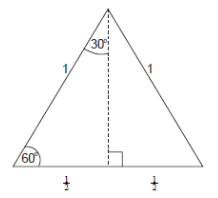
From the sketch opposite of an equilateral triangle,
sin 30° = \frac{\frac{1}{2}}{1} = \frac{1}{2}
| sin (−30°) | = −sin 30° (function is odd) |
| = − |
| Since | cos θ | = sin(90 − θ°) |
| cos 60° | = sin(90 − 60°) | |
| = sin 30° | ||
| = |
| cos 120° | = −cos 60° (function is odd about 90°) |
| = − |
In the example above, the relationship
cos θ = sin(90 − θ°)
was used.
Similarly, it should be noted that
sin θ = cos(90 − θ°)
The last function to consider here is tan x, which has rather different properties from sin x and cos x.
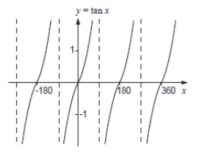
We can use a graphic calculator or computer to sketch the function
y = tan x
for x in any range. The period of the function is the distance between any two consecutive asymptotes; the period for y = tan x is 180°.
Unlike the sine and cosine functions, tan x is not bounded by ±1. In fact, as x increases to 90°, tan x increases without limit.
Using the values
tan 45° = 1 and tan 30° = \frac{1}{\sqrt{3}}
find, without using a calculator,
(a) tan 135° (b) tan (−45°) (c) tan 315°
(d) tan (−30°) (e) tan 150° (f) tan 60°
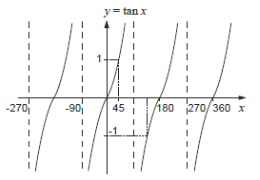
(a) tan 135° = tan (180° − 45°) = −tan 45° = −1
(b) tan (−45°) = −tan 45° = −1
(c) tan 315° = −tan 45° = −1
(d) tan (−30°) = −tan 30° = −\frac{1}{\sqrt{3}}
(e) tan 150° = −tan 30° = −\frac{1}{\sqrt{3}}
(f) tan 60° = = = = \frac{1}{\frac{1}{\sqrt{3}}} = \sqrt{3}
In (f), the result is equivalent to using
tan θ =
This is a useful property for the exercises below.
Further properties are summarised in section 5.
Exercises
