
Trigonometric functions can be used to model physical phenomena but applying these functions to problems in the real world will often result in a trigonometric equation to solve. In this section, you will consider some simple equations to solve. These will highlight the difficulties that can occur.
Worked Examples
Solve sin x = for 0° ≤ x ≤ 360°.
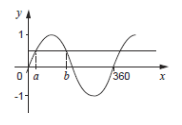
In solving equations of this sort it is vital to be aware that there may be more than one possible solution in the allowable domain - this possibility results from the periodic nature of this function. It is usually helpful to make a sketch of the relevant function, and this will help to identify the number of possible solutions.
In this case, the functions to plot are
y = and y = sin x
The points of intersection in the range 0° ≤ x ≤ 360° are solutions of the equation.
The figure shows that there are just two solutions, denoted by a and b, in the range. You can find the value of a by entering 0.5 in your calculator and using the 'inverse' sin or 'arc sin' buttons.
This gives a = 30° (or ≈ 0.524 radians, if you are using radians).
Your calculator will only give you this single value but it is easy to find b provide you have used a sketch. This shows that the function y = sin x is symmetrical about x = 90° and so b = 90° + 60° = 150° (≈ 2.618 radians). So the equation has two solutions, namely 30° or 150°.
Note
Even though your calculator cannot directly give you both solutions, it can be usefully used to check the answers. To do this enter 30° and press the button; similarly, for 150°.
If in the example above, the range had been −360° to 360°, there would be two further solutions. Using a sketch, you may like to consider what they would be. Again, you can check these solutions using the button on your calculator.
Solve 3 cos x = −0.6 for 0° ≤ x ≤ 360°, giving your answer to 1 d.p.
Rearranging the equation
cos x = − = −0.2
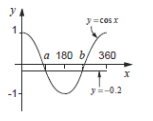
As before, you plot the functions
y = cos x and y = −0.2
There are two solutions, a and b, with a between 90° and 180°and b between 180° and 270°. Enter −0.2 into your calculator and use the ‘inverse’ cosine button - this will give you the answer
a = 101.5°
From the graph, and using symmetry, the second solution, b, is given by
| b = 180° + 180° − a ≈ 78.5° | |
| ⇒ | b = 258.5° |
and to 1 d.p. the solutions are 101.5° and 258.5°.
(Remember to check the second solutions on your calculator.)
What would be the solutions to the previous problem if the range had been given as −360° ≤ x ≤ 0° ?
Solve the equation tan x = −2 where x is measured in radians and −2π ≤ x ≤ 2π.
Give your answers to 2 d.p. (Set your calculator to radian mode.)
Note that x is given in radians rather than degrees here and remember that π radians ≡ 180°.
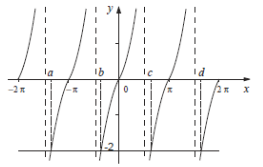
The graph of y = tan x and y = −2 is shown opposite.
You can see that there are four solutions denoted by a, b, c and d.
To find one of these solutions, enter −2 in your calculator and use the 'inverse tan' (or 'arctan' )button. This should give −1.107 radians, so that b = −1.107 .
Since the function tan x has period π (or 180°),
a = b − π = −4.249
b given above
c = b + π = 2.035
d = b + 2π = 5.177
To 2 decimal places the solutions in radians are
−4.25, −1.11, 2.04 and 5.18
Exercises
