

There are a number of important properties, which you have already been using. These are summarised below:
| Degrees | Radians |
| 1. cos (x) = sin (90° − x) | cos (x) = sin ( − x) |
| 2. sin (x) = cos (90° − x) | sin (x) = cos ( − x) |
| 3. cos (180° − x) = −cos(x) | cos (π − x) = −cos(x) |
| 4. sin (180° − x) = +sin (x) | sin (π − x) = sin(x) |
| 5. tan x = | |
| 6. sin2 x + cos2 x = 1 |
The last result is a very important one and is proved below for 0 < x < 90°.
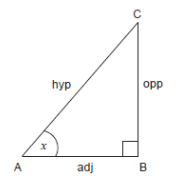
Theorem
sin2 x + cos2 x = 1
Proof
Using Pythagoras' Theorem,
BC2 + AB2 = AC2
Dividing by AC2,
()2 + ()2 = 1.
But
sin x = =
cos x = =
giving
sin2 x + cos2 x = 1
Note
sin2 x is used for (sin x)2 so that there is no confusion between (sin x)2 and sin(x2). These properties can be used to solve more complex trig equations.
Worked Examples
Find all solutions between 0° and 360° of the equation
sin x = 2 cos x to 2 d.p.
Assuming cos x ≠ 0, you can divide both sides of the equation by cos x to give
tan x = 2
(since = tan x).
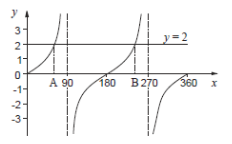
The graph of y = tan x and y = 2 is shown opposite. This shows that there are 2 solutions in the range 0° to 360°.
Using a calculator, the inverse tangent of 2 is 63.4° (to 1 d.p.). This is marked A on the graph. Since the tangent graph has a period of 180°, B is given by
63.4° + 180° = 243.4°.
Note that at the start of the solution, cos x = 0 was excluded.
When cos x = 0, this gives sin x = 0. These two equations are not both true for any value of x.
Find all solutions between 0° and 360° of the equation
cos x sin x = 3 cos x
giving answers to 1 d.p.
The equation can be rewritten as

cos x sin x − 3 cos x = 0
or
cos x (sin x − 3) = 0
So either cos x = 0 or sin x − 3 = 0 ⟹ sin x = 3
The graph of y = cos x is shown opposite for 0° ≤ x ≤ 360°. The solutions are given by cos x = 0, which gives
x = 90° or 270°
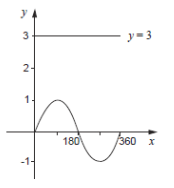
The other possibility is sin x = 3. The graph of y = sin x and y = 3 are shown opposite.
They do not intersect so there are no solutions.
The only solutions of the equation are therefore x = 90° or 270°.
The example above showed that algebraic techniques like factorising can be applied to equations involving trigonometric functions. The next example shows that quadratics in sines or cosines can also be solved.
Find all solutions between 0° and 360° to the equation
3 cos x = 2 sin2 x
This equation contains a mixture of 'cos' and 'sin' terms, but using the identity
cos2 x + sin2 x = 1
will make it possible to express the equation in 'cos' terms only.
Now
sin2 x = 1 − cos2 x
so that the equation becomes
| 3 cos x | = 2(1 − cos2 x) |
| = 2 − 2 cos2 x |
Hence
2 cos2 x + 3 cos x − 2 = 0.
(This is a quadratic equation in cos x.)
This can be factorised to give
(2 cos x − 1)(cos x + 2) = 0
and either
2 cos x − 1 = 0 or cos x + 2 = 0
The first equation gives
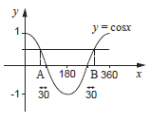
cos x =
and the graphs of y = cos x and y = are shown in the figure opposite
Using the inverse cosine function on a calculator gives x = 60° and this corresponds to A on the figure. Using symmetry about 180° gives B as
270° + 30° = 300°
The second equation, cos x = −2, has no solutions. The only possible solutions of the original equation are 60° and 300°.
Exercises
